

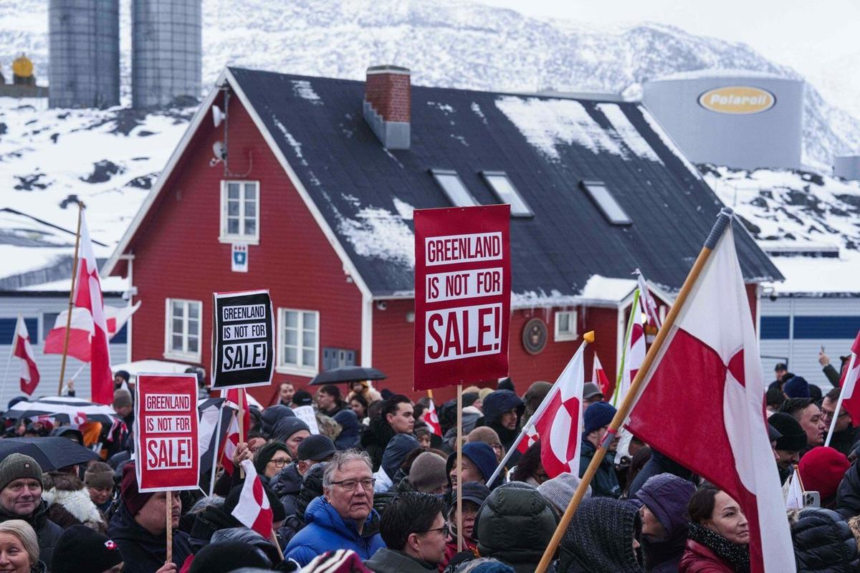
Not Going Down Without a Fight”: 10 Key Moments as 5,000+ Protesters March in Greenland Against Trump’s Takeover Threat
Thousands march across Greenland in a powerful show of resistance as protests erupt over Donald Trump’s takeover threat. Here are the key points and global reactions
Greenland witnessed one of the largest public demonstrations in its modern political history as thousands of citizens poured onto the streets to protest former U.S. President Donald Trump’s renewed rhetoric suggesting a possible American “takeover” of the Arctic island. Chanting slogans such as “We are not for sale” and “Our land, our future,” protesters sent a clear and defiant message: Greenland’s sovereignty is non-negotiable.
The demonstrations, which unfolded across major towns including Nuuk, Sisimiut, and Ilulissat, came amid growing international concern over the strategic implications of Trump’s statements, which critics say undermine democratic norms and territorial integrity. Protesters waved Greenlandic flags, held placards condemning foreign interference, and accused global powers of treating the Arctic region as a geopolitical chessboard.

The immediate trigger was Donald Trump’s recent reiteration of his long-standing interest in acquiring Greenland—a self-governing territory within the Kingdom of Denmark. Though Trump first floated the idea during his presidency in 2019, calling it a “large real estate deal,” his renewed comments have reignited outrage, fear, and political mobilisation within Greenland.
For many Greenlanders, the language used—suggesting the island could be acquired “one way or another”—crossed a dangerous line. Political analysts argue that such rhetoric normalises coercive diplomacy and raises uncomfortable questions about how major powers view smaller nations and autonomous territories.
“This is not just about Trump,” said one protest organiser in Nuuk. “This is about respect, self-determination, and our right to decide our own future.”
One of the most striking aspects of the protests was the broad political unity they displayed. Leaders from across Greenland’s political spectrum—ranging from pro-independence activists to those advocating continued ties with Denmark—condemned any suggestion of foreign takeover.
Several lawmakers addressed crowds, emphasising that Greenland’s future must be shaped by its people alone. Civil society groups, student unions, indigenous rights organisations, and environmental activists also joined the marches, turning the demonstrations into a nationwide expression of resistance.
Observers noted that public mobilisation on this scale is rare in Greenland, underscoring the depth of concern sparked by the controversy.
Greenland’s strategic importance has grown dramatically in recent years. Located between North America and Europe, the island plays a key role in Arctic security, global shipping routes, and climate research. Melting ice has opened new maritime passages and exposed vast reserves of rare earth minerals, oil, and gas—resources critical to modern technology and global supply chains.
The United States already maintains a military presence at Pituffik Space Base (formerly Thule Air Base), making Greenland a vital component of NATO’s Arctic strategy. However, critics argue that strategic cooperation must not morph into territorial ambition.
“Security partnerships are one thing. Claiming ownership is another,” said a Copenhagen-based foreign policy expert. “That distinction matters deeply to Greenlanders.”
Denmark’s government moved swiftly to reiterate its support for Greenland’s autonomy and territorial integrity. Danish officials described Trump’s remarks as “unhelpful” and stressed that Greenland is not for sale—now or ever.

European leaders and international observers also weighed in, warning that aggressive rhetoric over territory could destabilise already fragile geopolitical balances, particularly in the Arctic, where Russia, China, and NATO nations are all vying for influence.
The United Nations has repeatedly affirmed the principle of self-determination, and legal experts note that any attempt to forcibly acquire territory would violate international law.
For many protesters, the issue went beyond geopolitics. Marchers spoke passionately about identity, culture, and historical trauma.
Greenland’s Inuit population has long grappled with the legacy of colonialism, and the idea of being “bought” or controlled by another power resonated painfully with that past.
“We have spent decades reclaiming our voice,” said a young activist holding a sign reading ‘We Decide’. “No foreign leader gets to threaten that.”
Elders, students, families with children, and even local artists joined the marches, transforming city centres into vibrant yet resolute spaces of civic expression.
Environmental activists used the moment to highlight concerns that foreign control could accelerate resource exploitation at the expense of fragile Arctic ecosystems. Greenland is already on the frontline of climate change, with melting glaciers contributing significantly to global sea-level rise.
Protesters warned that increased militarisation or unchecked mining could permanently damage the environment and undermine indigenous ways of life.
“Greenland is not a resource warehouse,” one banner read. “It’s our home.”
Trump’s fascination with Greenland dates back to his presidency, when reports emerged that his administration had explored the possibility of purchasing the territory from Denmark. The idea was widely mocked at the time but also criticised as emblematic of a transactional approach to foreign policy.
Though no formal proposal was ever made, Trump’s comments strained U.S.–Denmark relations and sparked global debate about modern imperialism.
His latest remarks, delivered amid an increasingly volatile global political climate, have been interpreted by critics as an attempt to project strength while appealing to nationalist sentiments.
Many analysts believe the protests could mark a turning point in Greenland’s political evolution. Public discussions about independence, international alliances, and economic self-reliance have intensified in recent years, and the demonstrations have further energised civic engagement.
Younger Greenlanders, in particular, are demanding a more assertive voice on the world stage—one that prioritises dignity, sustainability, and democratic values.

“This is about defining who we are,” said a university student in Nuuk. “And making sure the world listens.”
While Trump currently holds no official power, his statements have undeniably reignited debate and exposed vulnerabilities in global governance norms. Greenlandic leaders are now expected to push for stronger diplomatic assurances, clearer international messaging, and increased investment in local institutions.
Experts say the episode serves as a reminder that words matter in international politics, especially when spoken by influential figures with global reach.
For Greenland, the message from the streets is unmistakable: the island will not be bullied, bargained over, or silenced.
Read Also : What Is HRANA? The US-Based Group Behind Iran’s 2,571 Protest Death Toll Figures

