India AI Summit 2026 Day 4: Top 10 Highlights from PM Modi’s ‘MANAV Vision’ for Responsible AI Future
India AI Summit 2026 Day 4 LIVE: 7 key takeaways as Narendra Modi unveils ‘MANAV Vision’ for ethical, inclusive AI governance shaping India’s digital future
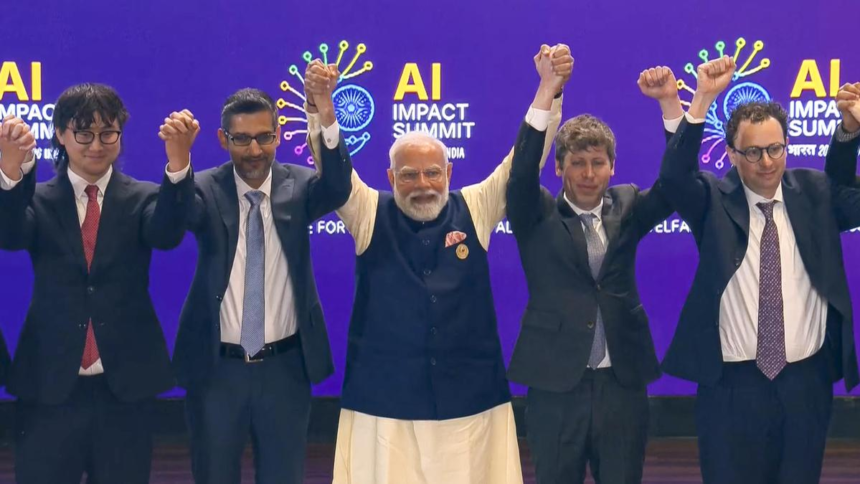
The fourth day of the India AI Summit 2026 marked a defining moment in the country’s digital transformation journey, as Prime Minister Narendra Modi unveiled the ambitious ‘MANAV Vision’ — a framework aimed at ensuring ethical, inclusive, and human-centric artificial intelligence governance. Positioned as India’s blueprint for responsible AI development, the announcement drew global attention from policymakers, industry leaders, researchers, and tech innovators.
The summit, which has become one of the most influential platforms for AI discourse in the Global South, saw Day 4 focusing heavily on governance, safety, accessibility, and innovation. With the MANAV Vision, India signaled its intent not just to adopt AI rapidly but to shape its ethical evolution globally.
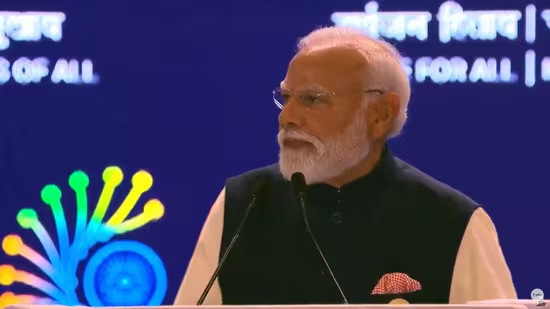
The term MANAV is being described as a multi-layered initiative representing India’s philosophy of human-first technology. According to officials, the framework revolves around five pillars: Morality, Accessibility, Neutrality, Accountability, and Value-driven innovation.
Unlike traditional AI roadmaps focused on economic impact alone, the MANAV Vision puts human dignity, societal well-being, and cultural diversity at the center. The announcement emphasized that India’s AI growth must align with constitutional values and democratic safeguards.
The Prime Minister emphasized that AI must augment human capabilities rather than replace them. He stressed that innovation should empower citizens across sectors, including agriculture, healthcare, education, and governance. The MANAV Vision aims to ensure that AI remains a tool for social progress rather than inequality.
2. Ethical AI Governance Framework
A major highlight was the proposal for a comprehensive ethical AI governance policy. This includes guidelines for fairness, transparency, and algorithmic accountability. The government hinted at introducing regulatory mechanisms to prevent bias in AI systems and ensure ethical use in both public and private sectors.
Experts at the summit noted that India’s approach could offer a middle path between heavy regulation and laissez-faire AI development seen in other parts of the world.
3. AI for Inclusive Growth
The MANAV Vision places strong emphasis on bridging the digital divide. Initiatives announced include AI tools in regional languages, rural AI innovation hubs, and public-private partnerships to deploy AI-driven solutions in underserved areas.
By focusing on accessibility, India hopes to ensure that AI benefits extend beyond urban centers and tech-savvy populations, reaching small businesses, farmers, and local governance institutions.
4. Open AI Infrastructure for Developers
Another key announcement was the push for open AI infrastructure. The government is exploring a federated model that allows startups, academic institutions, and independent developers to access computing resources, datasets, and models.
This move is expected to reduce barriers to entry and encourage indigenous AI innovation. Officials also hinted at expanding national AI compute facilities to support research and development at scale.
5. Global South AI Alliance
India proposed building a coalition of developing nations to shape inclusive global AI policies. The Global South AI Alliance aims to promote data equity, fair representation in global AI standards, and collaborative innovation among emerging economies.
The proposal received strong interest from delegations across Asia, Africa, and Latin America, many of whom share concerns about AI monopolies and technological dependency.
6. AI Safety and Misinformation Controls
In light of growing concerns about deepfakes and AI-generated misinformation, the MANAV Vision includes provisions for AI safety frameworks. This includes watermarking AI-generated content, public awareness campaigns, and collaborations with social media platforms.
Experts believe this could be a critical step in combating election interference, online fraud, and information manipulation — challenges increasingly linked to generative AI.
7. Skilling India for the AI Era
A major focus of Day 4 was workforce readiness. The government outlined plans to train millions in AI-related skills through universities, online platforms, and vocational programs.
The emphasis is not just on advanced AI roles but also on integrating AI literacy across disciplines. From teachers and healthcare workers to civil servants, the initiative aims to create an AI-aware society.
The MANAV Vision has already sparked strong reactions from the global tech community. Industry leaders praised India’s balanced approach, noting that it blends innovation with responsibility.
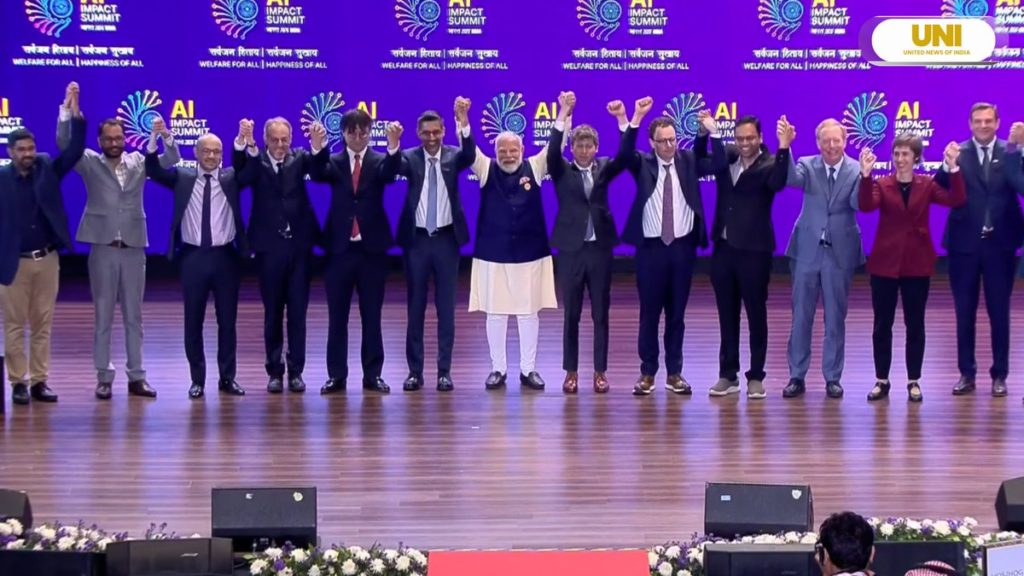
Tech CEOs attending the summit described the vision as a “third path” in AI governance — one that avoids overregulation while ensuring ethical safeguards. Several multinational firms also announced collaborations with Indian institutions to support research and innovation aligned with the framework.
Academics and policy experts highlighted the importance of India’s stance in global AI debates, especially as discussions around AI regulation intensify worldwide.
The India AI Summit 2026 itself reflects the country’s rapidly rising influence in the AI ecosystem. Over the past few years, India has emerged as one of the fastest-growing AI markets, driven by a vibrant startup ecosystem, large data pools, and a robust digital public infrastructure.
Government initiatives such as AI research funding, digital public goods, and AI adoption in governance have already positioned India as a key player. The unveiling of the MANAV Vision further strengthens this leadership narrative.
Observers believe that India’s demographic diversity and scale make it uniquely positioned to develop AI solutions that are inclusive and globally adaptable.
Despite the optimism, experts caution that implementation will be the real test. Key challenges include ensuring data privacy, building robust AI regulations without stifling innovation, and addressing skill gaps.
There are also concerns about balancing open innovation with security risks, especially as AI systems become more powerful. Maintaining transparency and accountability across both public and private deployments will be crucial.

Additionally, achieving true inclusivity will require sustained investments in infrastructure, digital literacy, and local-language technologies.
As the summit heads into its final sessions, attention is shifting toward policy rollouts and international partnerships. Officials have hinted that detailed white papers and implementation timelines for the MANAV Vision will be released soon.
Stakeholders are also expecting follow-up announcements related to AI regulation, cross-border collaborations, and investment frameworks.
The coming months will likely determine how quickly India can translate its vision into actionable policy and measurable outcomes.
Read Also : Ramadan Moon Sighting 2026 LIVE: 1 Crucial Date & Time Update — When Will the Holy Month of Ramadan Begin