Opposition’s Demand for Digital Election Data Sparks Debate Over Transparency and Modernization
In a political climate already charged with electoral tensions, the latest disagreement between the Opposition and the Election Commission of India (ECI) has added another layer to the ongoing debate on electoral transparency. DMK leader and Member of Parliament Kanimozhi has brought renewed attention to the issue by openly criticizing the ECI for allegedly failing to provide digital data related to elections, despite repeated demands from Opposition parties. Instead, the poll body has reportedly been supplying only physical, paper-based data — a move that, according to critics, undermines modern expectations for accountability and accessibility in India’s democratic process.
Kanimozhi’s statement has resonated strongly among several Opposition leaders who have been pressing for greater digital transparency in the electoral process. The demand for digital data is not merely a call for convenience; it represents a larger push towards ensuring that election-related information is easily accessible, verifiable, and free from manual discrepancies. By limiting access to paper records, the ECI is, in the eyes of the Opposition, clinging to outdated practices that slow down scrutiny and limit broader public engagement with crucial electoral information.
The core of the issue lies in the format and accessibility of election data. Opposition parties argue that in an era where governance and public services are increasingly digitized, election-related data should also be made available in a secure and standardized digital format. Such a move would allow for more robust analysis, encourage independent verification, and strengthen voter trust in the democratic process. Critics contend that sticking to paper-based records in 2025 is a step backward, especially when India has the technological capacity to implement far more transparent systems.
From the ECI’s perspective, however, the picture may be more complex. Sources suggest that the Commission’s caution could stem from concerns about data security, misuse of sensitive information, or potential cyber vulnerabilities. The digital storage and transmission of large volumes of electoral data require stringent safeguards, and the ECI may fear that premature digitization without airtight systems could open the door to hacking attempts or manipulation. Nevertheless, Opposition parties have countered this argument by pointing out that many government departments — including those managing equally sensitive data — have successfully transitioned to secure digital platforms.
Kanimozhi’s remarks have further fueled the narrative that the ECI must modernize its approach to align with global best practices. Countries around the world have been experimenting with digital election records, blockchain-based verification systems, and real-time public access portals. India, with its vast and diverse electorate, arguably has even more to gain from such innovations. Proponents of digital access highlight the potential for enhanced transparency, quicker dispute resolution, and improved trust between voters and the system.
The demand for digital election data has also gained traction among civil society groups, election watchdogs, and technology experts. Many argue that physical data is prone to damage, tampering, and logistical delays, whereas secure digital formats can be backed up, cross-verified, and made available to stakeholders without physical barriers. In the age of instant information, delays in accessing electoral data can influence public narratives and, potentially, electoral outcomes.
Kanimozhi’s intervention is part of a broader Opposition strategy to pressure the ECI ahead of upcoming state and national elections. By framing the issue as one of technological backwardness and transparency, the Opposition aims to mobilize public opinion around the need for modernization. The dispute also touches on deeper questions about the role of technology in democracy, the balance between security and openness, and the adaptability of India’s electoral institutions in a rapidly changing world.
The coming weeks are likely to see heightened political exchanges on this matter, with both sides preparing to justify their positions. Whether this debate will lead to concrete reforms remains to be seen. For now, the disagreement has drawn national attention, reigniting conversations about the future of election management in the world’s largest democracy.
To fully understand the current friction between the Opposition and the Election Commission of India (ECI), it is essential to trace the historical trajectory of how election data has been recorded, stored, and shared in the country. India’s electoral system is one of the largest and most complex in the world, encompassing over 900 million eligible voters spread across diverse geographies, languages, and socio-economic backgrounds. The methods and formats for collecting and sharing electoral data have evolved significantly since the nation’s first general elections in 1951–52, but modernization has not always been uniform or complete.
The Early Days: Manual Processes and Physical Records
In the decades immediately following independence, elections were conducted entirely through manual processes. Voter rolls, ballot papers, and result sheets were maintained in physical form, meticulously handwritten or typed. These records were often bulky, requiring physical storage and careful archiving. The Election Commission operated in an era where the physical paper trail was considered the gold standard for authenticity. While tamper-proof in some respects, this method was slow, labor-intensive, and vulnerable to environmental damage such as floods, fires, and pests.
Transition to Electronic Voting Machines (EVMs)
The late 20th century marked a significant technological leap with the introduction of Electronic Voting Machines (EVMs) in a phased manner starting in the 1990s. This innovation drastically reduced counting times, minimized invalid votes, and brought a new level of efficiency to elections. However, the supporting infrastructure — particularly in terms of data recording and dissemination — remained rooted in physical documentation. Results, while generated electronically, were often printed and stored in paper form for official record-keeping, rather than being integrated into comprehensive digital databases.
The Voter Verifiable Paper Audit Trail (VVPAT) Era
The 2010s saw another step forward with the implementation of Voter Verifiable Paper Audit Trails (VVPATs), designed to address concerns over EVM tampering. While VVPATs enhanced transparency by creating a paper record of each vote cast, they also reinforced the continued reliance on physical records. This paradox — the use of advanced voting technology alongside manual documentation — has persisted, and it is at the heart of today’s debate.
The Opposition’s Argument for Digital Transparency
The current Opposition push for digital data is rooted in the belief that India’s electoral ecosystem has matured enough to handle secure digital systems. They point out that numerous government departments, including the Income Tax Department, UIDAI (for Aadhaar), and the Ministry of Corporate Affairs, already manage vast and sensitive databases online. These systems have built-in layers of encryption, access controls, and audit trails, demonstrating that secure digitization is both possible and practical in the Indian context.
Moreover, global precedents exist for digital transparency in elections. Countries like Estonia have embraced fully online voting, while others such as Canada and Australia provide extensive electoral data in downloadable, machine-readable formats. The Opposition’s demand is not for experimental technology but for adopting tested digital frameworks adapted to India’s unique scale and complexity.
Resistance from the ECI
The ECI’s reluctance to share data digitally has been interpreted by some as a sign of institutional caution, but by others as a lack of willingness to embrace reform. The Commission has historically positioned itself as a non-partisan guardian of the electoral process, which may explain its preference for conservative measures that minimize perceived risks. However, in a rapidly digitizing world, excessive conservatism can be viewed as stagnation — and this is precisely the image the Opposition hopes to leverage in its criticism.
The dispute over data formats is not merely a technical matter; it is an indicator of broader tensions between institutional authority and democratic accountability. The Opposition’s framing of the issue seeks to cast the ECI as resistant to transparency, thereby appealing to voters who see technology as a means of empowerment and fairness.
While the political discourse surrounding the Election Commission of India’s data-sharing practices often makes headlines, the deeper conversation requires understanding the technical, legal, and cybersecurity dimensions of the debate. Experts in election technology, data governance, and cybersecurity have long warned that the transition from paper-based to digital systems is not merely a matter of convenience but a strategic shift with far-reaching implications for electoral integrity.
The Case for Digitization: Efficiency, Accessibility, and Transparency
Supporters of digital data argue that the modernization of India’s electoral information systems is long overdue.
They cite three primary advantages:
- Efficiency — Digital records can be processed, searched, and analyzed far faster than physical documents. Researchers, political parties, and journalists could access large datasets instantly, enabling real-time electoral analysis.
- Accessibility — Paper records are inherently limited in reach; they require physical presence or formal requests. Digital data could be made available through secure portals, allowing stakeholders across the country — and even in the diaspora — to examine election results, voter turnout statistics, and demographic trends without bureaucratic delays.
- Transparency — Publicly accessible, machine-readable datasets allow independent audits and fact-checking, reducing the potential for misinformation. In an era where social media narratives can shape public perception, having an authoritative, verifiable digital source can counter false claims more effectively.
These points are amplified by the Opposition’s argument that the Election Commission, as a constitutional body, should actively embrace tools that enhance public trust rather than relying on decades-old paper-based methods.
The Case Against Immediate Digitization: Cybersecurity and Manipulation Risks
However, cybersecurity professionals urge caution. Their primary concern is that centralized digital electoral data could become a high-value target for cyberattacks.
Potential threats include:
- Hacking and Data Breaches — Even heavily encrypted government databases are not immune to intrusion attempts. Sensitive voter information, if compromised, could be misused for identity theft or targeted political propaganda.
- Foreign Interference — In a geopolitically sensitive nation like India, adversarial states could seek to disrupt or discredit electoral processes by tampering with digital records or spreading manipulated datasets.
- Loss of Redundancy — Paper records provide an offline, tamper-evident backup in case of digital system failures or disputes. Eliminating them entirely could remove an important safeguard in contested elections.
Global case studies illustrate these dangers. In 2016, the U.S. experienced a wave of cyber intrusions into state election systems, prompting a massive investment in cybersecurity upgrades. Similarly, Ukraine’s 2014 presidential election faced an attempted hack that could have altered public perception of the results had it succeeded.
The Middle Path: Hybrid Models
Recognizing the strengths and vulnerabilities of both paper and digital systems, several democracies have adopted hybrid models that balance innovation with security. These include:
- Parallel Record-Keeping — Maintaining both paper and digital records, allowing each to serve as a check against the other.
- Read-Only Digital Access — Creating secure, non-editable online databases that can be publicly viewed but not altered without physical verification.
- Independent Cybersecurity Audits — Engaging third-party agencies to conduct periodic audits of electoral data infrastructure.
This approach acknowledges the value of modernization without abandoning the reliability of paper-based safeguards. In India’s case, it could mean that while official result forms continue to be signed, sealed, and stored physically, they are also scanned, digitized, and uploaded for secure public access.
Political Optics and Public Perception
The heart of the current controversy is not purely technological — it is also about how the Election Commission’s decisions are perceived. By continuing to share only paper-based data, the ECI risks appearing outdated, secretive, or resistant to scrutiny. The Opposition’s strategic narrative positions the demand for digital data as a demand for “openness,” thereby framing the Commission’s stance as one of “opacity.”
Public opinion often hinges on optics rather than technical nuances. For many citizens — especially younger, tech-savvy voters — the refusal to provide data digitally seems counterintuitive in an age where banking, taxes, and even health records have successfully migrated online.
The August 11 protest march to the Election Commission headquarters was not a spontaneous outburst of dissent — it was the culmination of weeks of political positioning, public statements, and escalating confrontations between the Opposition and the Election Commission of India (ECI). To fully understand its significance, one must trace the series of events that brought tensions to a boiling point.
The Build-Up: From Parliamentary Disruptions to Street Protests
The demand for digital electoral data had been simmering for months, but the debate took a sharper turn during the monsoon session of Parliament. Opposition MPs repeatedly raised the issue during Question Hour, alleging that the ECI’s reluctance to share digital data amounted to denial of transparency.
The government benches countered by accusing the Opposition of politicizing procedural matters, insisting that the Election Commission operates independently and within its own established norms.
As exchanges grew sharper, parliamentary proceedings were frequently disrupted, with walkouts staged by Opposition leaders. These disruptions spilled beyond the walls of Parliament, with leaders taking the message directly to the streets.
Escalating Rhetoric and Public Messaging
In a coordinated series of press conferences, leaders from the Congress, DMK, Samajwadi Party, and other INDIA bloc constituents framed the ECI’s approach as regressive and opaque.
Key themes in their messaging included:
- Public Right to Know — Positioning digital data as a citizen’s right rather than a privilege granted by the Commission.
- Election Modernization — Drawing parallels with other government departments that have embraced digital records.
- Global Standards — Citing examples from countries like the UK, Canada, and Australia where electoral results are posted online within hours.
Social media campaigns amplified these points, using hashtags like #DigitalDataNow and #ElectionTransparency to rally public attention.
Trigger Events: The Final Straw
Several incidents in late July served as catalysts for the August 11 march:
- Letter to the ECI Ignored — A formal letter from Opposition leaders, signed by representatives from over a dozen parties, requesting digital access to election data reportedly went unanswered for weeks.
- The Paper-Only Briefing — During a scheduled briefing on election preparedness, ECI officials provided paper-based summaries to party representatives, rejecting requests for machine-readable datasets.
- Statements from Senior Leaders — DMK MP Kanimozhi, in an interview, openly criticized the ECI’s stance, saying, “In a digital age, giving paper data is like asking the public to read by candlelight when the electricity is on.” The statement went viral, framing the debate in a relatable metaphor.
By early August, the Opposition had framed the issue as not merely administrative but symbolic — a struggle between an outdated bureaucracy and a modern, tech-aware democracy.
The Symbolism of the March
The decision to stage the march on August 11 was strategic. Parliament was in session, ensuring media coverage, and the date fell just days before Independence Day, allowing leaders to weave themes of democratic freedom and citizen empowerment into their speeches.
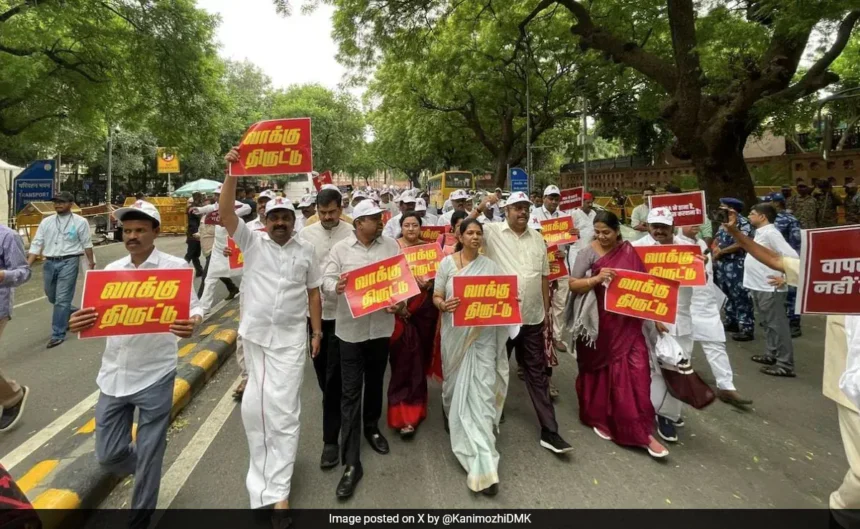
Opposition leaders announced that the march would be peaceful but visibly defiant, with MPs walking from Parliament to the ECI office carrying both digital devices and paper sheets — a theatrical representation of the very debate at hand.
Confrontation and the Dramatic Visuals
On the day of the march, tensions escalated quickly. Barricades were set up along the route, and police presence was heavy.
Several high-profile moments captured public attention:
- Akhilesh Yadav Jumping Barricades — The Samajwadi Party chief’s bold move was widely circulated in video clips, becoming a symbol of the Opposition’s willingness to physically challenge restrictions.
- Rahul Gandhi’s Detention — The Congress leader, along with several MPs, was briefly detained, a move that the Opposition framed as an attempt to silence democratic protest.
- Chants of ‘Digital Data Now’ — The unifying slogan was heard throughout the march, ensuring that the central demand remained the focus despite the confrontations.
These moments, replayed across television channels and social media feeds, ensured that the march achieved its primary goal — keeping the demand for digital electoral data at the center of national political discourse.
Also Read : High Drama at Opposition March to EC — Akhilesh Yadav Jumps Barricade, Rahul Gandhi Detained