

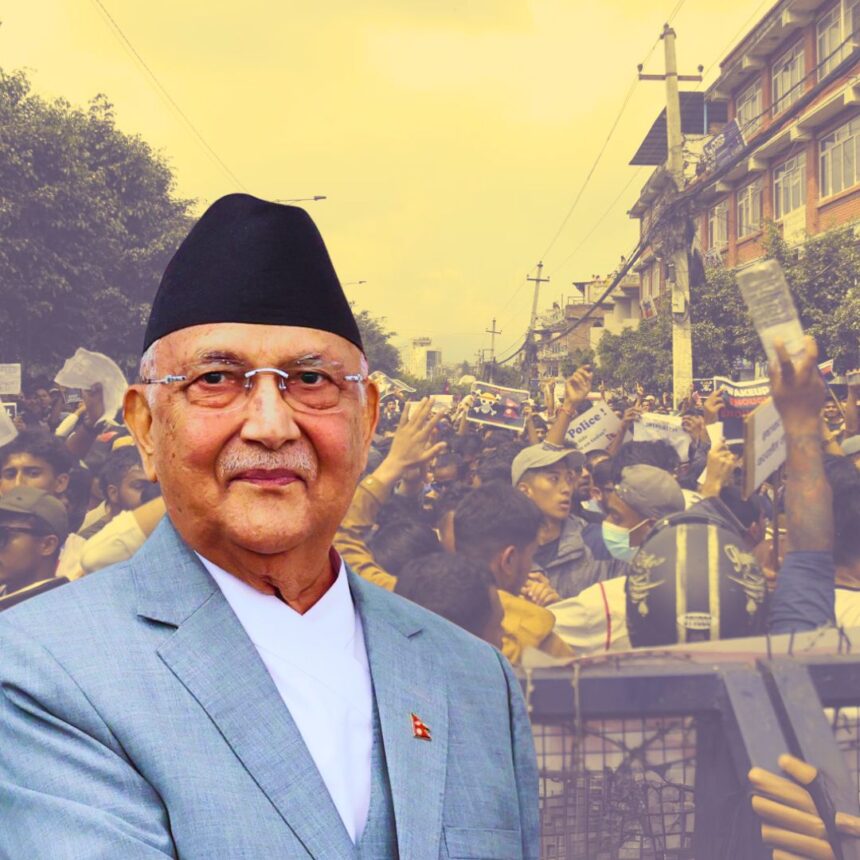
Nepal’s PM Oli Resigns Amid Violent Gen Z Protests over Social Media Ban & Corruption
New Delhi: Nepali Prime Minister K.P. Oli tendered his resignation on Tuesday (September 9) amid escalating protests in the country, his secretariat announced.
“Considering the extraordinary situation prevailing in the country and in order to facilitate further efforts toward a constitutional political solution and problem resolution, I hereby resign from the office of Prime Minister, effective immediately, under Article 77(1)a of the Constitution,” Oli wrote in his letter to Nepal’s President Ramchandra Paudel, the Himalayan reported.
The paper also has it that protesters breached the parliament walls for the second consecutive day and entered the Federal Parliament building.
Tensions in Nepal escalated sharply on Tuesday (September 9) after protesters, in defiance of the curfew put in place on Monday afternoon, set fire to the homes and offices of the top political leadership of the country, including Oli’s private residence in Balkot, Bhaktapur.
Other houses set on fire include those of President Poudel, former home minister Ramesh Lekhak, Nepali Congress leader Sher Bahadur Deuba and leader of the Communist party of Nepal Maoist Pushpa Kamal Dahal. A school owned by Nepali foreign minister Arzu Deuba Rana was also set on fire, AP reported.
The Kathmandu Post reported that the Nepal Army has begun evacuation of ministers from their residences using helicopters amid reports of arson and vandalism.
The situation in the Himalayan nation took a turn for the worse after the Nepal police opened fire on demonstrators on Monday, killing 19 and injuring more than 400.
The mass protests in Nepal were prompted by a social media ban on platforms like Instagram, Facebook and YouTube, amid wider discontent with the Oli government that has been accused of widespread corruption.
The spontaneous protests are being seen as the result of growing irritation with the government, political failure and alleged corruption.
Oli had earlier announced an all party meeting on Tuesday evening as the protests entered the second day. “I am saddened by Monday’s protests in the capital and across the country and the subsequent incidents,” he said. “No form of violence serves the nation’s interest, and we must pursue a peaceful and dialogue-based solution,” he said.
The prime minister had said that he was in talks with all relevant parties to put an end to the crisis.
Ministers step down, curfews imposed
Three ministers have stepped down since the protests began on Monday.
Nepal’s home minister Ramesh Lekhak submitted his resignation to Oli during a cabinet meeting on Monday evening, followed by agriculture minister Ramnath Adhikari and water supply minister Pradeep Yadav.
Curfews were imposed in different areas of Kathmandu, Lalitpur and Bhaktapur districts on Tuesday, but have done little to deter the public from taking to the streets.
Last week, Nepal’s government following a Supreme Court order decided to block access to major social media platforms that had not registered with the communications and information technology ministry in line with a 2023 set of directives.
At the time none of the large global firms including Meta, Alphabet, X, Reddit and LinkedIn had applied to register with the ministry. On the other hand TikTok, Telegram and Viber were among a handful of platforms that had registered or had applied to register.
Despite the lifting of the social media ban, demonstrations continued on Tuesday in parts of Kathmandu Valley, including New Baneshwar, Kalanki and Chapagaun, where protesters chanted slogans against corruption and lit tyres on fire. Police made several arrests near the Federal Parliament building.
India, UK, US and others urge restraint
In a statement released Tuesday morning India said it was “deeply saddened by the loss of many young lives” in Nepal’s protests and urged that the crisis be addressed through “peaceful means and dialogue.”
India also conveyed condolences to the families of those killed, while wishing a speedy recovery to the injured. “As a close friend and neighbour, we hope that all concerned will exercise restraint and address any issues through peaceful means and dialogue,” the statement said.
A joint statement was also issued by the Embassies of Australia, Finland, France, Japan, the Republic of Korea, the United Kingdom, and the United States of America in Nepal on Monday evening.
“We are deeply saddened by the violence seen in Kathmandu and elsewhere in Nepal today, including the tragic loss of life and injury during demonstrations. We extend our sincere condolences to the families of the victims, all those affected, and wish those injured a swift and full recovery.
Our governments reaffirm our strong support for the universal rights of peaceful assembly and freedom of expression. We urge all parties to exercise maximum restraint, avoid further escalation, and ensure that these fundamental rights are protected,” the statement said.
International and national rights organisations, including the UN’s human rights office and Nepal’s National Human Rights Commission, condemned the killings and called for prompt investigations, urging the government to respect freedom of assembly and expression.

