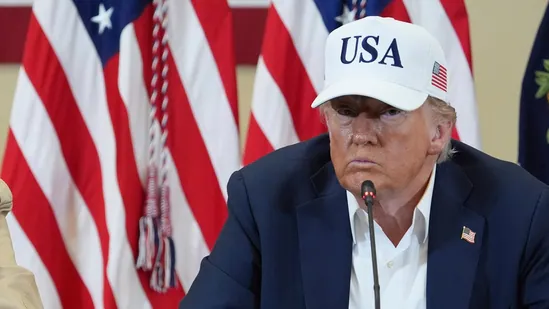
Trump’s Tariff Playbook Returns: Letters to Mexico and the EU Ignite New Trade Storm
The Return of Economic Nationalism Ahead of 2024
With the U.S. presidential election season heating up, former President Donald Trump has reintroduced one of the most polarizing tools from his previous administration: tariff diplomacy. In a move that echoes his first-term trade war strategies, Trump has released a fresh set of tariff warning letters directed at Mexico and the European Union, indicating that a future Trump White House would once again seek to reshape global trade rules through confrontation, leverage, and bilateral pressure.
The timing of the release is far from incidental. As Trump campaigns for a second term, these letters serve not merely as foreign policy posturing, but as core campaign messaging. They reflect his ongoing commitment to what he has often branded as “America First economics”—a worldview that sees global supply chains, multinational agreements, and economic interdependence not as strengths, but as vulnerabilities.
In the letters, which were obtained and published by key media outlets including the Hindustan Times and Fox Business, Trump outlines grievances about trade imbalances, alleged unfair subsidies, and what he describes as decades of American manufacturing erosion due to “foreign manipulation and globalist betrayal.” Mexico is accused of benefiting disproportionately from North American trade flows, while the European Union is called out for maintaining what Trump refers to as “massively one-sided auto tariffs” and regulatory barriers.
Though short in length, the letters are long on symbolism. They signal a clear intent to return to aggressive tariff policies if elected, revive protectionist rhetoric, and reassert American economic dominance through unilateral tools rather than multilateral consensus.
A Flashback to the Trump Doctrine on Trade
To understand the implications of these new letters, it is necessary to revisit the trade doctrine that defined Trump’s first term in office. From 2017 to 2021, Trump imposed a wide array of tariffs on China, steel and aluminum imports, European goods, and even Canadian dairy products, often using Section 232 of the Trade Expansion Act of 1962—a national security provision rarely used in modern trade disputes.
His administration tore up the Trans-Pacific Partnership (TPP), renegotiated NAFTA into the USMCA, and frequently clashed with the World Trade Organization (WTO). For Trump, trade was never simply about economic growth—it was about restoring national pride, protecting industrial jobs, and reasserting sovereignty over American commerce.
While critics argued that these policies disrupted global supply chains, triggered retaliatory tariffs, and hurt U.S. farmers and manufacturers in the long term, Trump and his supporters claimed they brought adversaries to the table, corrected long-standing trade deficits, and reignited domestic manufacturing—a key appeal to Rust Belt voters and economic nationalists.
The release of these new letters suggests that Trump plans to double down on that legacy, framing the 2024 race not only as a referendum on immigration and crime, but on who controls the economic destiny of the United States.
Why Mexico and the EU—and Why Now?
That Trump chose Mexico and the European Union as targets of his latest tariff warnings is no coincidence. Both regions are not only key trading partners of the United States but also pivotal actors in the Biden administration’s re-globalization strategy, particularly as it seeks to counterbalance China’s influence through diversified supply chains and regional alliances.
Mexico, for instance, has become the largest U.S. trading partner in 2023, overtaking China due to rising tariffs on Chinese goods and companies seeking to “nearshore” operations closer to North American markets. But in Trump’s view, this shift has only benefited Mexican industry and workers, at the cost of American factories and wages.
The letter to Mexico reportedly raises concerns about agricultural imports, auto parts, and cross-border labor practices, and hints at the possibility of revisiting the USMCA if Trump is reelected. While the agreement was one of his signature trade deals, his new critique suggests dissatisfaction with its enforcement or evolution under the Biden administration.
The letter to the European Union, meanwhile, brings back familiar complaints about automobile tariffs, state-backed green energy subsidies, and regulatory restrictions on American tech and pharmaceuticals. Trump accuses the EU of using its bureaucracy to “crush American innovation” and threatens a reciprocal tariff regime if what he sees as trade discrimination continues.
European leaders, already wary of a potential Trump return, view this letter as a warning shot, a sign that multilateralism may again be sidelined in favor of transactional bilateralism—and that transatlantic unity on climate, defense, and supply chains could once again be disrupted.
Strategic Messaging for the 2024 Base
These letters are not just foreign policy instruments—they are campaign documents. By targeting two major economic blocs, Trump is speaking directly to his electoral base: working-class voters in industrial states, many of whom feel left behind by globalization and trade liberalization.
The language in the letters echoes stump speeches delivered at campaign rallies in Pennsylvania, Michigan, and Ohio. Terms like “job theft,” “economic betrayal,” and “America gets nothing” appear both in the documents and on stage. They are calibrated to resurrect the emotional appeal of the 2016 and 2020 campaigns, in which trade was framed not as policy, but as a fight for national dignity and economic sovereignty.
At a recent rally in Toledo, Trump declared: “Other countries build factories, we lose jobs. Other countries protect their industries, we open the floodgates. But not anymore. We’re putting tariffs back on the table, and we’re putting American workers first.”
Such messaging isn’t just rhetorical—it’s deeply strategic. Trump knows that tariff politics resonate far beyond Washington, especially in swing states where economic anxieties remain high despite national GDP growth. The letters are part of a broader effort to reignite a cultural and economic rebellion against elite trade consensus.
As Donald Trump’s newly released tariff warning letters to Mexico and the European Union make global headlines, the economic and diplomatic fallout is already beginning to take shape. The letters—delivered with characteristic bluntness—have triggered a range of responses from international markets, trading partners, and multinational corporations, many of whom now face the unsettling possibility that a second Trump administration would reopen long-dormant trade conflicts that had only recently begun to stabilize.
Though the letters do not yet carry the legal force of policy, they are seen by allies and adversaries alike as a credible preview of Trump’s economic agenda should he win the 2024 presidential election. Markets have taken notice. Currency shifts, investor hesitations, and trade bloc responses are already forming a global front of cautious recalibration.
Initial Market Response: Caution, Volatility, and Political Risk Premium
Within 24 hours of the public release of the tariff letters, financial markets responded with wariness. The euro saw a marginal dip against the dollar, not due to immediate economic impacts, but because of what traders described as the “reemergence of geopolitical trade risk.” In North America, Mexican bonds saw a minor selloff, particularly in sectors tied to exports like automotive and agriculture.
More importantly, investor conversations began to refocus on a scenario that had previously seemed distant: the reemergence of a Trump-style trade war. Hedge funds and global investment houses issued risk notes flagging a “potential 2025 tariff shock” should Trump return to the White House. JPMorgan’s global markets team published a warning that the “regulatory uncertainty and retaliatory potential of Trump’s tariff posture could stifle trade recovery and increase investor flight to safe assets.”
In practical terms, companies are now reassessing 2024–25 investment strategies. For firms that rely heavily on cross-border trade—especially those with complex supply chains touching Mexico or the EU—the fear isn’t just about tariffs themselves, but about regulatory unpredictability. If past is prologue, then a future Trump administration would likely announce tariffs via social media, executive orders, and national security waivers, often without traditional notice or coordination with U.S. allies or business groups.
European Union Reaction: Strategic Patience, But Growing Frustration
In Brussels, Trump’s letter to the European Union was met with measured but unmistakable frustration. EU Trade Commissioner Valdis Dombrovskis issued a formal statement reaffirming the bloc’s commitment to “fair and rules-based trade under WTO principles” while warning that “unilateral tariff threats erode the trust necessary for economic cooperation.”
Privately, however, EU officials were more blunt. A senior official in the European External Action Service told Politico Europe: “This isn’t about trade anymore. It’s about whether we are viewed as equal partners or economic opponents. The European Union will not be bullied into concessions.”
European business leaders are especially alarmed at Trump’s direct targeting of auto exports—a perennial grievance in his trade rhetoric. The EU automotive sector, led by Germany, accounts for billions in annual exports to the U.S., and past threats of tariffs on German vehicles created severe anxiety in markets and prompted diplomatic backchanneling. Trump’s new letter, which criticizes “unfair EU practices that cripple American carmakers,” has resurrected these tensions.
In response, European policymakers are considering preemptive trade insurance programs and diplomatic hedges, including deeper trade engagement with China, Latin America, and Southeast Asia to reduce exposure to a potentially combative U.S. trade policy post-2024.
Mexico’s Strategic Dilemma: Dependent, Yet Defensive
Perhaps the most diplomatically vulnerable player in this new tariff equation is Mexico. As a direct neighbor and the United States’ largest trading partner in 2023, Mexico’s economy is deeply integrated with U.S. markets, especially in the automotive, electronics, textiles, and agriculture sectors.
The letter Trump directed at Mexico criticizes “manipulative trade advantages,” “lenient labor enforcement,” and an “unfairly tilted playing field” in auto part manufacturing. While the wording echoes his 2019 threat to impose tariffs unless Mexico curbed migration flows, this new version adds sharper economic language, implying that Mexico is benefiting from the post-China trade pivot without meaningful concessions.
In response, Mexican President Andrés Manuel López Obrador (AMLO) struck a diplomatic tone, stating, “We are committed to fair trade, mutual respect, and the stability of North America. Let’s not return to threats. Let us build on USMCA and not unravel what has worked.”
However, Mexico’s options are limited. Over 80% of its exports go to the U.S., and sectors like auto parts, avocados, and processed goods are particularly vulnerable to new tariffs. Moreover, political uncertainty in the U.S. has already begun affecting foreign direct investment in Mexican border towns and industrial corridors.
Some Mexican strategists argue that AMLO—and his likely successor Claudia Sheinbaum—should use this moment to accelerate diversification into South American, Asian, and European markets. Others suggest re-engaging China more aggressively, a path that could aggravate Trump further but offer strategic leverage in the long term.
U.S. Business Reaction: Divided Interests and Growing Anxiety
Within the United States, reactions from the business community have been mixed—but increasingly tense. Industry groups such as the U.S. Chamber of Commerce, National Association of Manufacturers, and American Farm Bureau Federation issued carefully worded statements urging “measured and collaborative trade policy,” while stopping short of directly criticizing Trump.
Behind closed doors, however, business executives are deeply alarmed. The memory of retaliatory tariffs during the Trump administration still lingers, especially among U.S. agricultural exporters, who suffered when China, the EU, and Mexico imposed countermeasures in response to earlier rounds of U.S. tariffs.
A soy farmer in Iowa, speaking to Bloomberg, said: “I voted for Trump. Twice. But I lost contracts in China and Mexico because of tariffs. If he does that again, I don’t know how we survive another round.”
Manufacturers, particularly in the Midwest and Southeast, are also nervous. Many rely on just-in-time supply chains involving parts from Mexico and Europe. The return of tariff threats complicates price forecasting, contract stability, and capital investment planning.
However, some segments of the American business world welcome the letters. A growing number of nationalist-leaning business lobbies—including the America First Policy Institute—have praised Trump’s move, claiming that foreign manufacturers have been allowed to “exploit loopholes and lax enforcement” for too long. They argue that tariffs can correct structural imbalances and reshore critical industries.
This internal division—between globally integrated corporations and nationalist-oriented domestic producers—mirrors the broader political fault lines within the Republican Party itself. It suggests that trade policy will once again become a defining ideological battlefield in the 2024 election, not just between parties, but within them.
The re-emergence of tariff diplomacy under Donald Trump’s shadow campaign is not just triggering panic across global markets—it is reshaping the geopolitical conversation. With the release of his tariff threat letters to Mexico and the European Union, Trump is once again positioning trade policy not simply as an economic tool, but as a foreign policy weapon, tightly wound into his worldview of national sovereignty, economic self-reliance, and distrust of multilateralism.
While his critics see the move as a return to isolationism and unpredictability, his supporters argue it reflects a hardened realism about global competition. One thing is certain: Trump’s tariff threats are not isolated communications—they are structural signals, reverberating far beyond Washington and Wall Street. From Berlin to Beijing, from Ottawa to São Paulo, governments and industries are preparing for a potential seismic shift in how the world does business with the United States post-2024.
Global Economic Realignment: A Preemptive Shift from the Dollar Hub?
When Trump launched his original tariff campaign in 2018, most nations responded reactively. Few were prepared for the sweeping breadth of the trade war, particularly the ferocity of his actions against China, Canada, and the EU. But this time around, world economies are far more proactive—and far more skeptical.
The European Union is already expanding trade pacts with India, ASEAN, and South America, attempting to minimize overdependence on the U.S. market. The ASEAN bloc, after years of U.S.-China trade uncertainty, is pushing for greater internal market integration, trying to become a demand center rather than a passive manufacturing base.
China, meanwhile, sees Trump’s return as both a threat and an opportunity. On one hand, tariffs were central to the decoupling effort that led to lost exports and technology sanctions. On the other hand, Beijing anticipates that a renewed Trump-led conflict with Europe and Latin America may fracture Western unity, allowing China to reposition itself as a reliable partner in global supply chains—particularly in Africa and Central Asia.
Even U.S. allies like South Korea and Japan are hedging quietly. While maintaining strong security alliances with Washington, both countries are expanding trade linkages with non-Western economies, including India, Indonesia, and Brazil. Trump’s letters have validated long-standing concerns: U.S. trade policy, under him, is bilateral, transactional, and prone to whiplash.
For many, the message is clear: diversify before 2025.
Tariffs as Foreign Policy: Merging Trade, Migration, and Military Pressure
What distinguishes Trump’s tariff approach from traditional economic protectionism is its fusion with other domains of foreign policy—particularly immigration control and military leverage. In his worldview, economic pressure is not an isolated lever but a way to influence everything from refugee policy to defense burden-sharing.
Consider the 2019 episode when Trump threatened Mexico with across-the-board tariffs unless it cracked down on Central American migration. The threat was sudden, blunt, and legally questionable—but it resulted in Mexico deploying thousands of National Guard troops to its southern border. It was a textbook example of how Trump uses trade as geopolitical blackmail.
His 2024 letters echo that strategy. In the Mexico letter, while framed around manufacturing, there are repeated references to “cross-border violations,” “sovereign imbalance,” and “social disorder”—language that clearly gestures toward immigration, cartel violence, and U.S.-Mexico border dynamics.
In the EU letter, the focus on auto tariffs is peppered with subtle references to “defense burden-sharing” and “national security standards,” invoking a Trumpian logic where NATO contributions and trade surpluses are linked. It’s not just about cars—it’s about power. And Trump has consistently argued that all U.S. alliances must yield transactional returns, or be restructured.
Thus, if Trump is re-elected, expect his second-term trade policy to be more than economic—it will be coercive, cross-sectoral, and deeply entwined with his broader worldview of America as a global enforcer, not a consensus-builder.
Trade War 2.0? What a Renewed Global Tariff Escalation Might Look Like
With Trump leading in Republican primary polling and the general election within striking distance, businesses, governments, and policy think tanks are now modeling what a second Trump trade war could realistically look like. The worst-case scenarios aren’t academic—they’re logistical, political, and deeply disruptive.
Here are a few potential flashpoints that economists and geopolitical analysts are now flagging:
- Auto Tariffs on Europe and South Korea: If Trump reimposes Section 232 tariffs on imported vehicles, the impact on Germany, Japan, and South Korea would be massive. In retaliation, the EU could target U.S. tech, luxury goods, and agricultural exports.
- Reworking or Exiting USMCA: Trump could demand new labor provisions, enforce stricter rules of origin, or even threaten to suspend the agreement, throwing North American trade into uncertainty and pushing firms to relocate operations yet again.
- China Tariff Supercycle: Trump may not only maintain existing tariffs on China but expand them to include consumer electronics, pharmaceuticals, and green tech components—further deepening the tech cold war.
- WTO Paralysis: Trump could block appointments to the World Trade Organization Appellate Body, already weakened during his first term, effectively freezing global dispute resolution mechanisms and making trade retaliation a free-for-all.
- Tariff-for-Immigration Leverage: Expect a repeat of the Mexico strategy—this time possibly targeting Central American nations, Colombia, or African countries deemed non-cooperative on migration or law enforcement.
Each of these scenarios carries significant risks: inflationary pressure, supply chain distortion, weakened global growth, and a dangerous re-politicization of trade. But to Trump’s base, these are acceptable costs for national sovereignty—or even necessary sacrifices.
The Biden Doctrine: A Steady Hand or a Globalist Relic?
In contrast, the Biden administration’s trade policy has emphasized multilateral engagement, ally-shoring, and long-term supply chain resilience. Initiatives like the Indo-Pacific Economic Framework (IPEF), revitalized WTO diplomacy, and strategic tariff exemptions have sought to repair alliances damaged by Trump’s combative style.
But critics argue that Biden has been cautious to the point of timidity. Tariffs on Chinese goods remain largely intact. The TTIP (Transatlantic Trade and Investment Partnership) remains dormant. And while Biden emphasizes worker-centered trade, his administration has yet to deliver any landmark trade agreement that expands U.S. market access.
This creates a narrative vacuum that Trump is eager to fill. Where Biden offers predictability and quiet diplomacy, Trump offers drama, decisiveness, and disruption—and for some voters, particularly in the Midwest and South, that contrast is compelling.
The Biden campaign is now reportedly preparing a counteroffensive: a messaging effort that rebrands Trump’s trade approach as “economic chaos”, arguing that unpredictability is not strength. Expect new proposals that blend pro-worker tariffs, green industrial policy, and enforcement-heavy trade rules to counter Trump’s message while retaining liberal values.
Also Read : Rahul Gandhi Pleads Not Guilty in ₹100 Cr Defamation Case Over Savarkar Remark – Court Hearing Held in Pune