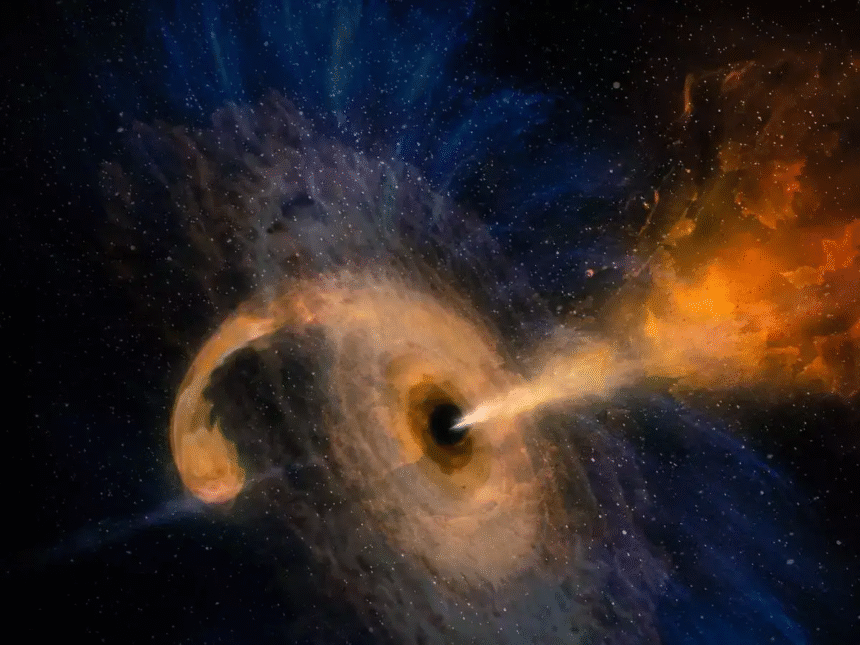
Indian Scientists Detect Mysterious Flickers from Supermassive Black Hole 12 Times Heavier Than the Sun – A Groundbreaking Cosmic Discovery
In a stunning astronomical event, Indian scientists have detected mysterious flickers of light from a black hole 12 times the mass of the Sun. This could unlock new secrets about black hole behavior and space-time physics in 2025
In a distant part of our galaxy, something flickers. Not stars or comets, but a black hole’s strange light. This unusual signal has drawn scientists‘ attention for years. Now, Indian researchers have uncovered what lies behind this cosmic whisper.
The black hole, named GRS 1915+105, lives 28,000 light-years away. It hides inside a binary system with a companion star. The star’s material falls inward, forming a spinning disc. This disc heats up, glowing fiercely in X-ray light. These X-rays help scientists watch what eyes cannot see.
GRS 1915+105 is no ordinary black hole system. It holds a black hole twelve times heavier than our Sun. The spinning disc around it reaches millions of degrees. A hot cloud called the corona hovers above the disc. This corona is where things get truly interesting.
India’s AstroSat, launched in September 2015, tracks this system. The observatory uses two X-ray tools, LAXPC and SXT. Together, they monitor the black hole’s changing brightness. Sometimes, the light drops suddenly into a quiet phase. At other times, it flares up and flickers rapidly.
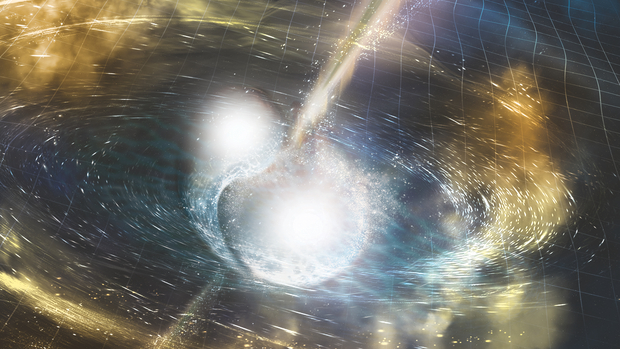
During the bright spells, flickers repeat 70 times each second. These flickers are known as quasi-periodic oscillations, or QPOs. The flickers disappear when brightness drops again. This on-off behaviour puzzled researchers until now.
Scientists found that the flickers come from the corona. When the black hole glows, the corona shrinks and heats up. But when it dims, the corona expands and cools down. These changes match the appearance and disappearance of flickers.
Top to bottom: Time variation of intensity, frequency (〖ν〗_(QPO) ), ‘super-heated’ corona size (R_(in) ) and luminosity (L) for GRS 1915+105 observed with AstroSat (Image: ISRO)
The study was led by researchers from several Indian groups. They include experts from ISRO, IIT Guwahati, and the University of Haifa. Their work is now published in the Monthly Notices of the Royal Astronomical Society.
These findings illustrate the nature of black holes when conditions are extreme. Courtesy AstroSat, India is assisting in unearthing such cosmic secrets. GRS 1915+105 is distant, but it continues to speak in light and Indian researchers are hearing.
In a stunning cosmic revelation, a team of Indian astrophysicists has observed unusual flickers of light emerging from a black hole nearly 12 times the mass of our Sun. The discovery, made using India’s cutting-edge space observatory systems, has triggered excitement across the global scientific community and could significantly alter our understanding of black hole physics and X-ray emissions.
The observations were made using AstroSat, India’s first dedicated multi-wavelength space observatory, operated by the Indian Space Research Organisation (ISRO) and associated academic institutions like TIFR and IUCAA.
The team detected strange, rhythmic flickers—a phenomenon technically called quasi-periodic oscillations (QPOs)—coming from the vicinity of a stellar-mass black hole located in a binary system within the Milky Way.
This black hole, estimated to be 12 times more massive than our Sun, is devouring a companion star. As the matter spirals into the black hole’s accretion disk, it emits powerful X-rays, which were captured and analyzed by AstroSat’s Large Area X-ray Proportional Counter (LAXPC).
These mysterious light fluctuations are not random. Scientists observed a repeating flicker pattern every 0.2 seconds, which they say could indicate new behaviors in black hole accretion mechanics and energy emission.
These unique flickers could point to turbulence or instability in the space-time fabric around the black hole. It challenges traditional models of how matter behaves under extreme gravity.
This is one of the most significant black hole-related discoveries made using an Indian-built space observatory. It reinforces India’s growing leadership in space exploration and astrophysics.
The findings will be compared with data from NASA’s NICER, ESA’s XMM-Newton, and the Event Horizon Telescope, helping form a global picture of how black holes feed and flicker.
The oscillations may help researchers test Einstein’s Theory of General Relativity in environments of extreme gravity, where current models begin to break down.
The data will undergo further analysis using AI-based modeling and deep-space imaging to better understand what causes these unique flickers. A potential follow-up mission or collaboration with international observatories is being planned.
The discovery could also shape future Indian missions like XPoSat, ISRO’s upcoming X-ray Polarimeter satellite.