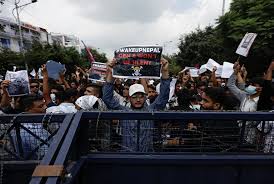
Nepal Gen Z Protests in Kathmandu Against Corruption and Social Media Ban
Kathmandu, the vibrant capital of Nepal, has long been a city where culture, politics, and public sentiment intersect. In recent weeks, the heart of the Himalayan nation has become the stage for an extraordinary movement—led not by seasoned politicians, but by Generation Z, the youngest and most dynamic demographic of the country.
The immediate spark was the government’s controversial decision to ban major social media platforms—Facebook, YouTube, X (formerly Twitter), and Instagram—allegedly to curb “misinformation.” Yet, beneath this decision lies a deeper story: one of youth frustration with corruption, lack of opportunities, and a governance system perceived as out of touch with their realities.
This protest wave represents more than a clash over digital rights. It is a profound struggle for dignity, transparency, and the right to speak freely in an era where social media is the lifeline of expression, connection, and livelihood.
The Social Media Ban: Catalyst for a Movement
The government’s sudden move to restrict social media shocked millions of Nepalese citizens. Platforms like Facebook and Instagram are not only used for communication but also for small businesses, activism, education, and global connectivity. For many young Nepalese, these apps are part of their daily survival—whether selling handmade crafts online, promoting startups, or engaging in freelance digital work.
By cutting off this digital ecosystem, the state inadvertently triggered an uprising among its most technologically connected citizens. Protests erupted in Kathmandu within hours, with slogans demanding “Digital Freedom, Political Accountability, and an End to Corruption.”
Why Generation Z Is Leading
Unlike older generations, Nepal’s Gen Z grew up post-monarchy, in a fragile democracy shaped by coalition politics, promises of development, and recurring disappointments.
Key reasons why Gen Z is leading the movement:
- Digital Natives – They rely on online platforms for jobs, creativity, and activism.
- Frustration with Corruption – Many believe the political elite have failed to provide transparency or opportunities.
- Global Outlook – Through social media, they compare Nepal’s governance with international standards.
- Unemployment Crisis – Thousands of young people migrate abroad every year for work; protests are also an outlet for demanding a future at home.
Their presence in the streets represents not just anger, but hope for systemic change.
Voices from the Ground
In Kathmandu’s New Road and Durbar Marg areas, chants of “No More Silence, No More Corruption!” echoed as students, professionals, and young entrepreneurs gathered.
- Anisha, 22, a university student:
“We are not protesting only for social media. We are protesting because the system has ignored us. Corruption steals our future.” - Rohit, 25, a small business owner:
“Instagram was my shop. When they banned it, they destroyed my livelihood. But more than that, they destroyed trust.”
These voices reflect the dual frustration: both economic and political.
Political Context: A System Under Pressure
Nepal’s politics is dominated by old guard leaders from major parties who have rotated power since the end of the monarchy in 2008. Accusations of cronyism, slow reforms, and a lack of accountability have plagued successive governments.
The current ruling coalition faces allegations of mismanagement and corruption scandals involving infrastructure projects, tax policies, and misuse of state resources. The social media ban, therefore, is viewed not just as censorship, but as an attempt to silence critics and cover up failures.
For Gen Z, this was the breaking point.
International Reactions
Nepal’s protests have drawn attention globally. International watchdogs, human rights groups, and even foreign governments have expressed concern over the violation of digital rights.
- Amnesty International called the ban “a dangerous precedent for free speech in South Asia.”
- Global tech companies expressed worry, as Nepal represents a growing digital market in the region.
- Neighboring India has watched cautiously, given its influence in Nepalese politics and the presence of millions of Nepali migrants in India.
These reactions amplify the protests, putting Nepal under international scrutiny.
Symbolism of the Protest
What makes this protest unique is its symbolism:
- Young people holding placards with QR codes linking to banned social platforms.
- Silent marches where protesters raise their mobile phones with flashlights—representing the “light of truth” against corruption.
- Street art across Kathmandu showing chains around social media logos, symbolizing censorship.
This visual creativity reflects Gen Z’s ability to blend digital culture with street politics.
The Road Ahead
The protests are growing. Each day, more students and young professionals join. What began as an anger against a ban has evolved into a movement demanding political accountability and systemic reform.
Whether the government responds with dialogue or crackdown will determine the future. A crackdown risks alienating the entire young population, while dialogue could open doors for democratic renewal.
For now, the streets of Kathmandu are alive with chants, songs, and determination—a generation demanding to be heard.
Historical Roots of Corruption in Nepal
To fully grasp why Nepal’s Gen Z has taken to the streets, it’s essential to look at the long-standing history of corruption and political disillusionment in the country.
Since the abolition of the monarchy in 2008, Nepal transitioned into a federal democratic republic. The expectation was clear: democracy would bring accountability, transparency, and opportunities for citizens. However, the political reality unfolded differently.
- Frequent Government Changes: In just over 15 years, Nepal has witnessed more than a dozen governments. Each shift brought new coalitions, unstable leadership, and little continuity in governance.
- Cronyism and Patronage: Political appointments often favored loyal party members rather than qualified professionals, fueling inefficiency.
- Scandals and Mismanagement: From road construction deals to telecom licenses, allegations of inflated costs and kickbacks have been common.
- Taxpayer Distrust: Ordinary citizens feel their contributions are misused, leading to growing resentment.
The Gen Z protesters are not carrying the burden of historical loyalty to old political parties. For them, the failure of governance is not an abstract problem—it directly affects their future.
Economic Dimension: Why Youth Are Frustrated
Nepal’s economy relies heavily on remittances, with millions of young people working abroad in the Gulf, Malaysia, India, and beyond. In fact, nearly 25% of Nepal’s GDP comes from remittances.
This reality presents two harsh truths for Gen Z:
- Limited Opportunities at Home – Unemployment and underemployment force many young graduates to migrate.
- Brain Drain – The most talented often leave, depriving Nepal of innovation and progress.
The social media ban worsened the frustration because:
- Thousands of Nepali freelancers rely on platforms like Instagram, YouTube, and Facebook for digital income.
- Small businesses depend on online promotion to survive.
- Cutting off these channels felt like cutting off the country’s economic artery for youth.
Thus, the protests reflect both political corruption and economic suffocation.
The Role of the Nepali Diaspora
Nepali youth abroad have joined the protests in solidarity. In New York, London, and Sydney, small rallies were organized by diaspora groups, amplifying the movement on global media.
Social media may be banned inside Nepal, but through VPNs and diaspora networks, videos, hashtags, and live streams continue to spread globally. This digital solidarity shows:
- Youth abroad still feel deeply connected to Nepal.
- Diaspora voices increase international scrutiny of the Nepali government.
- Expatriates remind locals that their struggle resonates globally.
Protest Tactics: Creativity Meets Technology
Gen Z protests are distinct not only in purpose but also in style.
- Flashlight Protests: Thousands stand silently in Kathmandu squares, raising phone flashlights as symbols of digital freedom.
- QR Code Placards: Signs that link to information on corruption and censorship.
- Street Art: Murals depicting chains around social media logos or a broken lock over a smartphone.
- Silent Sit-ins: Demonstrators sit cross-legged in public areas, holding signs that read “Our Silence Is Louder Than Your Lies.”
Such tactics resonate deeply with a global audience, making the protests not just a national but also an international narrative of youth resistance.
Government Response: Defensive or Dialogic?
So far, the government’s stance has been defensive. Officials argue that the social media ban is temporary and intended to combat “misinformation and harmful content.” However, critics view this as an excuse to silence dissent and shield corruption scandals.
The leadership faces a dilemma:
- If they lift the ban, it may appear as though they bowed to pressure.
- If they enforce the ban further, protests could escalate into long-term unrest.
Either way, the government is under immense pressure to address corruption and youth discontent—something it has often postponed in the past.
Global Parallels: Nepal’s Gen Z Is Not Alone
The Kathmandu protests are part of a wider global trend where young people challenge entrenched power structures:
- Hong Kong (2019–2020) – Youth-led protests for democracy and autonomy.
- Sri Lanka (2022) – Young protesters occupied government buildings during an economic collapse.
- Iran (2022–2023) – Gen Z protests against restrictions and authoritarianism.
- Chile & Colombia – Youth-led movements against inequality and corruption.
Nepal’s youth uprising aligns with this global wave of digitally connected, politically conscious, and fearless Generation Z movements.
Emotional Power: A Fight for Dignity
At its core, the Kathmandu protests are not just about Facebook or Instagram. They are about dignity—the right to dream, express, and live in a country that respects its young citizens.
As one protest banner read:
“We don’t want to leave. We want to live.”
This emotional message encapsulates the heart of the movement: a generation unwilling to migrate silently, a generation determined to claim their future at home.
International Diplomatic Impact
While the protests are primarily a domestic movement, their international implications cannot be ignored. Nepal sits in a strategically sensitive location, sandwiched between India and China, with the United States and Europe also keeping an eye on its democratic stability.
- India’s Perspective:
India has deep historical, cultural, and economic ties with Nepal. Instability in Kathmandu often has ripple effects in New Delhi. Indian officials are concerned that prolonged unrest could push Nepal closer to China or destabilize border regions. At the same time, India’s youth have sympathized with the Nepali Gen Z protesters on social media, showing cross-border solidarity. - China’s Stance:
China traditionally prefers stability over democracy in its neighbors. Beijing views the protests with unease, fearing that youth-led uprisings in Nepal could inspire similar movements elsewhere. However, China is also pragmatic—it may seek to strengthen ties with whichever government remains in power, regardless of public opinion. - Western Reactions:
The U.S. and European Union have voiced concerns over digital freedom violations. Western embassies in Kathmandu have released statements urging the Nepali government to respect the rights of peaceful protesters and restore access to online platforms.
The protests have thus become more than a domestic crisis—they are also a test of Nepal’s foreign policy balancing act.
Media Narratives: Two Competing Stories
As with any mass movement, there are two distinct narratives emerging—one from the government and one from the streets.
- Government Narrative:
Officials insist that the ban on social media is temporary and necessary to control “misinformation, fake news, and destabilizing content.” They frame protesters as being influenced by foreign agendas or “irresponsible youth” who don’t understand the complexities of governance. - Protester Narrative:
Protesters counter this by pointing to years of corruption, failed leadership, and misuse of state resources. For them, the social media ban is a smokescreen—a way to silence whistleblowers and restrict youth voices.
Independent journalists in Nepal note that the truth leans heavily toward the protesters’ side. Stories of corruption scandals, inflated contracts, and lavish lifestyles of politicians have long circulated in Nepali media, reinforcing the credibility of the protesters’ claims.
Government Propaganda and Its Limits
To maintain control, the government has attempted several propaganda strategies:
- State-Controlled Media: Broadcasting narratives that the protests are small, foreign-backed, or disruptive.
- Blame Games: Accusing rival political parties of instigating the protests.
- Appeals to Nationalism: Suggesting that critics of the ban are undermining national security.
However, Gen Z is media-savvy. With access to VPNs, encrypted apps, and diaspora support, they are able to bypass censorship and share real-time footage of protests. This has limited the effectiveness of government propaganda.
Human Stories of Courage
Behind the headlines are stories of ordinary Nepali youth showing extraordinary courage:
- Priya, 19, a student activist:
Arrested briefly for painting anti-corruption graffiti, she told reporters: “They can silence me for a night, but they cannot erase our voice.” - Sanjay, 24, a digital freelancer:
Lost his income overnight when social media was banned. Instead of leaving the country, he joined the protests, saying: “I can rebuild my business if I have freedom. Without freedom, there is nothing.” - A group of young doctors:
Marched in white coats, holding signs that read “Corruption is the real disease.” Their symbolic presence resonated widely.
These human stories elevate the movement beyond politics, turning it into a moral fight for justice.
Potential Future Scenarios
As the protests intensify, several paths lie ahead for Nepal:
- Government Dialogue and Reform
- The leadership could lift the social media ban and open talks with youth representatives.
- This could lead to limited reforms and a temporary easing of tensions.
- Crackdown and Escalation
- If the government chooses repression—arrests, internet shutdowns, or violence—protests could spiral into a larger democratic crisis, risking international sanctions and deeper instability.
- Youth-Led Political Entry
- Some protest leaders may transition into political organizing, forming youth parties or alliances that challenge the old guard in elections.
- This could reshape Nepal’s political landscape in the coming years.
- Prolonged Stalemate
- The government might wait out the protests, hoping fatigue sets in.
- But given Gen Z’s determination, such a stalemate could transform into a long-term generational struggle.
Lessons for South Asia
Nepal’s protests are being watched carefully across South Asia. In countries like Bangladesh, Sri Lanka, and Pakistan, young populations face similar frustrations—corruption, censorship, and unemployment.
Kathmandu’s streets today may well be a preview of tomorrow’s struggles across the region.
Conclusion: The Dawn of a New Political Culture?
The Gen Z protests in Kathmandu are more than a battle over social media—they represent a generational demand for dignity, transparency, and opportunity.
Whether the movement succeeds or not, one truth is undeniable:
Nepal’s youth have entered the political stage, and they are unwilling to step back.
The chants echoing in Kathmandu—“No More Silence, No More Corruption”—signal the birth of a new political culture.
The Psychology of Youth Activism
Every mass movement has a psychological core, and in Nepal’s Gen Z protests, it is defined by a strong sense of betrayal mixed with hope.
For decades, the promise of democracy and development was dangled before Nepali citizens. Instead, they have witnessed a cycle of corruption, broken promises, and leadership failure. Gen Z, born after Nepal’s democratic struggles of the 1990s and 2000s, entered adulthood expecting better.
- Betrayal: They feel cheated by politicians who used democracy as a slogan but ruled with the same old patterns of nepotism and greed.
- Hope: Unlike older generations, Gen Z still believes things can change—through collective action, creativity, and persistence.
This dual psychology explains their intensity: protests are not just about resisting corruption but about defending their future.
Gender and Inclusivity in the Movement
A defining feature of this uprising is its inclusive character. Women, LGBTQ+ activists, and marginalized ethnic groups are not bystanders—they are at the forefront.
- Women as Leaders: Many protest marches are organized by young women who frame corruption as a feminist issue, arguing that misgovernance deepens inequality and limits opportunities for women.
- Ethnic Minorities: Groups historically excluded from Kathmandu’s political mainstream—Madhesis, Janajatis, Dalits—see this movement as a chance to demand equal treatment.
- Queer Voices: Rainbow flags have been spotted in protest sites, symbolizing that the fight against corruption is also a fight for dignity and recognition.
By being intersectional, the protests have avoided the trap of becoming “just another student protest.” Instead, they project themselves as a movement for everyone.
Echoes of Past Revolutions
Nepal is no stranger to uprisings. From the 1990 People’s Movement that restored democracy to the 2006 Jana Andolan that ended monarchy, street protests have been catalysts of transformation.
The Gen Z uprising draws inspiration from these past struggles but also sets itself apart:
- Different Enemy: Past movements fought against kings or dictators; this one fights against a corrupt democratic establishment.
- Different Tools: Earlier revolutions relied on newspapers and word-of-mouth; this one thrives on VPNs, encrypted chats, livestreams, and digital art.
- Different Spirit: Whereas older movements were framed in class or party terms, this one is generational—a youth declaring independence from failed elders.
Some scholars call it the “Third Democratic Awakening” in Nepal.
Technology as a Weapon of Resistance
Despite the social media ban, technology has become the engine of protest resilience.
- VPNs and Proxies: Young Nepalis are bypassing censorship, keeping Facebook, Instagram, and X alive underground.
- Encrypted Messaging: Apps like Signal and Telegram are being used for coordination, out of the government’s reach.
- Digital Creativity: Protesters share memes, posters, and short videos that combine humor with critique, making the movement engaging and accessible.
- International Amplification: Nepali diaspora groups are using global platforms to echo voices from Kathmandu, ensuring that the world doesn’t forget.
Technology is not just a tool—it has become a symbol of defiance. The government may control state TV, but the youth control the digital imagination.
Generational Contrast: Boomers vs. Zoomers
One striking feature of the protests is the visible generational divide.
- Older Politicians: Many are in their 60s or 70s, clinging to outdated politics, where patronage networks and personal loyalties mattered most.
- Gen Z Protesters: Born into a globalized, digital world, they prioritize transparency, merit, and fairness.
This contrast fuels anger. The youth look at their leaders and see not mentors, but gatekeepers of a broken system. The protests are, in essence, a generational rebellion.
Cultural Expressions of the Movement
Protests are not just political—they are cultural festivals of resistance. In Kathmandu, youth have turned protest sites into spaces of art and performance:
- Street Music: Local bands perform anti-corruption songs that spread quickly online.
- Graffiti Walls: Colorful murals depict politicians as puppets of greed, while celebrating the unity of youth.
- Poetry Nights: Young poets recite verses calling for justice, merging tradition with rebellion.
Such creativity makes the protests sustainable, preventing burnout and keeping morale high.
The Emotional Toll and Resilience
Prolonged protests bring exhaustion, fear, and uncertainty. Yet, the movement survives because of collective resilience.
Psychologists note that community solidarity—shared meals, group chants, late-night discussions—provides emotional armor. Protesters draw strength from knowing they are part of a historic moment bigger than themselves.
Conclusion: Toward a New Nepalese Identity?
The Gen Z protests are shaping more than politics—they are reshaping Nepalese identity.
A country once defined by its kings, wars, and fragile democracy is now being redefined by its youth, their creativity, and their insistence on fairness.
If successful, the protests could mark the birth of a Nepal where citizenship, not patronage, is the foundation of society.
And even if the immediate struggle falls short, the seeds of transformation have already been planted.