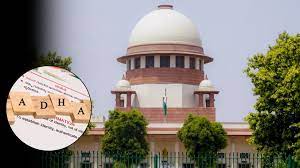
Supreme Court Directs EC to Publish Names of 65 Lakh Voters Omitted in Bihar SIR; Aadhaar Accepted as ID
In a country as diverse and populous as India, electoral integrity forms the cornerstone of democracy. Every vote represents not just a political preference, but the individual’s belief in the democratic process. Recent judicial directives have brought this principle into sharp focus, particularly in Bihar, where the Supreme Court of India has intervened in an unprecedented case involving the omission of 65 lakh eligible voters from the official rolls.
The matter came to light after several reports indicated large-scale deletions from the electoral database in Bihar’s Sir region, raising concerns about disenfranchisement ahead of crucial polls. The controversy deepened when it was revealed that in many cases, voters were removed without prior notice or due verification, often because of mismatched details during data linkage with Aadhaar. For a state already facing socio-economic challenges, the removal of such a significant number of voters is not a mere administrative lapse—it is a democratic alarm bell.
The Supreme Court’s directive to the Election Commission (EC) was both clear and urgent: publish the names of all 65 lakh voters who have been omitted and provide clarity on the reasons for their deletion. In an equally significant observation, the Court confirmed that Aadhaar would be acceptable as valid identification for voter registration purposes. This ruling is set to influence not just Bihar, but potentially every Indian state, as it brings to the forefront the debate over Aadhaar’s role in electoral processes.
This legal intervention does not exist in isolation. It comes against the backdrop of a broader national conversation about electoral transparency, data accuracy, and the rights of citizens in the digital age. From village assemblies to urban constituencies, questions are being raised about the fairness of the voter verification process, the technological infrastructure supporting it, and the accountability of election authorities.
The scale of the issue cannot be understated. In electoral terms, 65 lakh votes could swing the balance of power in more than one assembly segment, especially in a state like Bihar, where margins of victory are often razor-thin. Politically, the incident has ignited intense reactions from opposition parties, civil society organizations, and voter rights activists. Some allege that these deletions disproportionately affect marginalized communities, migrant laborers, and rural citizens—groups that already face systemic barriers to political participation.
This first part of the series lays the groundwork for an in-depth exploration of the case. Over the next parts, we will examine the legal framework governing voter registration, the technical aspects of voter list maintenance, testimonies from affected citizens, political ramifications, and the long-term implications for Indian democracy. By dissecting the situation from multiple angles, we aim to understand not only the “what” and the “how,” but also the “why” behind one of the most significant voter rights cases in recent memory.
Historical Context of Voter List Management in India
The foundation of India’s electoral process rests on one essential pillar: the voter list. Formally known as the Electoral Roll, it is not just a document—it is the living proof of the right to vote for over 900 million citizens. Over the decades, the process of preparing, maintaining, and updating this list has evolved, shaped by constitutional mandates, legislative reforms, technological upgrades, and occasional controversies.
From Paper Registers to Digital Databases
In the early decades after independence, voter registration was a labor-intensive, paper-based process. Booth-level officers went door-to-door, collecting details manually and compiling them into bulky registers. Errors were common—spelling mistakes, missing names, or duplicate entries. Despite these shortcomings, the system ensured a personal connection between election officials and the voter, minimizing the feeling of bureaucratic distance.
With the liberalization era in the 1990s and the subsequent push towards modernization, the Election Commission of India (ECI) began computerizing voter data. By the early 2000s, many states shifted to digital databases, enabling faster updates, better storage, and easier verification. However, the digital transformation also introduced new vulnerabilities—ranging from data mismatches to technical errors that could unintentionally remove eligible voters from the rolls.
Legal and Administrative Framework
Voter list preparation is governed primarily by the Representation of the People Act, 1950, which mandates the Election Commission to prepare and update electoral rolls annually. The law also provides mechanisms for citizens to apply for inclusion, correction, or deletion. Crucially, deletions are supposed to happen only after due notice is given to the concerned individual, ensuring no one is arbitrarily disenfranchised.
In practice, however, administrative lapses and procedural shortcuts have sometimes bypassed this safeguard. Mass deletions often occur during intensive revision exercises, especially when authorities attempt to remove “duplicate” or “ghost” voters.
The Aadhaar Linkage Factor
The integration of Aadhaar with voter registration—initiated under the National Electoral Roll Purification and Authentication Programme (NERPAP)—was intended to curb duplication. The logic was simple: linking voter ID with Aadhaar would allow authorities to identify and remove multiple entries for the same person.
However, in reality, this exercise sometimes led to the deletion of legitimate voters. Minor discrepancies in name spelling, address formatting, or date of birth between the Aadhaar database and the voter list were enough to trigger an automatic “mismatch” flag. In some states, these mismatches resulted in large-scale removals without proper verification.
Precedents of Large-Scale Omissions
Bihar’s recent case is not the first instance of mass voter deletion making headlines.
- In Telangana (2018), lakhs of names were found missing from electoral rolls just before state elections, sparking public outrage.
- In Andhra Pradesh (2019), the opposition alleged the removal of over 20 lakh voters.
- Even in urban centers like Delhi, periodic complaints surface about citizens discovering their names missing on polling day.
These incidents reveal a recurring pattern: technology-driven clean-up exercises, while well-intentioned, sometimes lack the human oversight necessary to safeguard genuine voters’ rights.
The Current Bihar Scenario
The omission of 65 lakh voters in Bihar fits into this historical and procedural context. The EC’s acknowledgment, coupled with the Supreme Court’s intervention, has turned the spotlight back on the balance between efficiency and inclusivity in voter list management. While digitization can streamline operations, it cannot replace the need for ground-level verification and citizen engagement.
Supreme Court’s Intervention and Observations
The Supreme Court’s decision to direct the Election Commission (EC) to publish the names of 65 lakh omitted voters in Bihar marks a significant moment in the jurisprudence of electoral rights in India. It is not merely a procedural directive; it is a reaffirmation of the fundamental principle that the right to vote is the lifeblood of democracy and must be protected against both administrative oversight and systemic inefficiencies.
The Trigger for Judicial Involvement
The case reached the Supreme Court after reports and petitions highlighted an unprecedented scale of voter name omissions during the electoral roll revision exercise in Bihar. Petitioners argued that such a large-scale deletion was not only alarming but also raised doubts about the transparency and fairness of the process.
They emphasized that under Article 326 of the Constitution, elections to the House of the People and Legislative Assemblies must be based on adult suffrage, making every eligible citizen’s inclusion in the electoral roll a constitutional necessity, not a bureaucratic favor.
Key Supreme Court Observations
During the hearings, the Supreme Court made several crucial observations:
- Transparency is Non-Negotiable – The Court noted that keeping the details of omitted voters undisclosed could create suspicion among the electorate. Publishing names would allow citizens to verify and, if necessary, challenge their removal.
- Aadhaar as an Acceptable ID – Addressing the identification issue, the Court reiterated that Aadhaar can be used as proof of identity for voter registration purposes, but clarified that it is not mandatory and cannot be the sole determining factor for inclusion or deletion.
- Due Process in Deletion – The Bench highlighted that deletions must follow due process, including prior notice to affected individuals. The absence of such notice in many cases was viewed as a violation of natural justice.
- Accountability of the Election Commission – The Court subtly reminded the EC that its constitutional autonomy comes with a corresponding duty to maintain public trust. Administrative lapses in something as fundamental as the electoral roll undermine democratic credibility.
Legal Precedents Reinforced
The ruling draws strength from earlier judicial pronouncements:
- In People’s Union for Civil Liberties vs. Union of India (2003), the Supreme Court emphasized that free and fair elections form part of the basic structure of the Constitution.
- In Anukul Chandra Pradhan vs. Union of India (1997), the Court underlined the necessity of an accurate and updated electoral roll to ensure fair representation.
By ordering the EC to publish the names of the omitted voters, the Court aligned this case with the broader legal principle that electoral transparency outweighs administrative convenience.
Implications for the Election Commission
The Supreme Court’s order carries immediate and long-term consequences for the EC:
- Immediate Compliance – The EC must now compile, verify, and publicly release the list of 65 lakh omitted names in a format accessible to citizens.
- Process Reforms – The order indirectly compels the EC to re-examine its data verification mechanisms, particularly where Aadhaar linkage or automated clean-up drives are involved.
- Precedent Setting – This ruling will likely serve as a reference in future electoral disputes, encouraging courts to intervene when large-scale voter omissions occur.
Democratic Significance
From a democratic perspective, the ruling reasserts that citizen trust in the electoral process is as important as the process itself. Even if administrative deletions are justified on technical grounds, they cannot come at the expense of disenfranchising millions without recourse or explanation.
Election Commission’s Response and the Political Storm
The Supreme Court’s order directing the publication of names of 65 lakh omitted voters in Bihar placed the Election Commission (EC) in a delicate position. As the custodian of India’s electoral integrity, the EC was now under intense scrutiny—not only from the judiciary but also from political parties, civil society groups, and the public at large.
Election Commission’s Official Statement
Following the Supreme Court directive, the EC issued a formal statement acknowledging the Court’s observations. In its response, the EC emphasized:
- Compliance Commitment – It assured that the list of omitted names would be compiled and published in a district-wise and constituency-wise format on its official website and through local electoral offices.
- Reasons for Omission – The EC attributed the large-scale deletions to factors such as migration, deaths, and duplication of entries due to Aadhaar-based verification drives. It maintained that the clean-up exercise was intended to improve electoral roll accuracy, not to disenfranchise eligible voters.
- Appeal for Public Cooperation – Citizens whose names were missing were urged to file Form 6 to re-enroll, with the EC promising a special facilitation drive to ensure quick reinstatement before upcoming elections.
Despite this clarification, skepticism persisted.
Public Reaction: Trust Erosion and Grassroots Frustration
For the public, particularly those in rural Bihar, the issue wasn’t merely administrative—it was personal. Reports emerged of citizens traveling long distances to polling stations in previous elections only to discover their names missing.
Civil society organizations criticized the EC for what they described as a “data-first, people-later” approach, arguing that Aadhaar linkage exercises often failed to account for socio-economic realities like lack of digital access, literacy barriers, and limited documentation.
Social media platforms amplified this sentiment, with hashtags such as #VoterListScandal and #65LakhVoices trending nationally. The narrative shifted from a bureaucratic glitch to a symbol of voter disenfranchisement in the eyes of many.
Political Parties Step Into the Arena
The controversy quickly became a political flashpoint.
- Opposition’s Allegations – Several opposition parties alleged that the omissions disproportionately affected marginalized communities, migrant laborers, and first-time voters, claiming this could influence electoral outcomes in favor of ruling parties. Leaders called for an independent audit of the deletion process and accused the EC of failing its constitutional mandate.
- Ruling Party’s Counter – The ruling party dismissed these allegations as “baseless fear-mongering”, framing the clean-up exercise as an essential step toward modernizing India’s electoral database. They accused the opposition of politicizing a technical process for electoral gains.
- Regional Party Voices – In Bihar’s competitive political landscape, regional parties saw the issue as a tool to mobilize voter sympathy. Several leaders launched door-to-door awareness campaigns to help citizens check and restore their voter registrations, using the controversy to strengthen grassroots connections.
The Media’s Role
News channels and digital platforms covered the story extensively, often framing it in terms of democratic erosion vs. administrative necessity. Editorials debated whether the EC’s push for data purity through Aadhaar integration was inadvertently undermining inclusivity, one of the cornerstones of Indian democracy.
Some media outlets even drew parallels with previous voter roll controversies in other states, warning that Bihar’s case could set a dangerous precedent if systemic reforms were not implemented.
A Deepening Divide
By this stage, the controversy had evolved into a three-way narrative battle:
- The Supreme Court positioned itself as the guardian of electoral fairness.
- The Election Commission sought to defend its procedural legitimacy while repairing public trust.
- The political class leveraged the situation to either demand accountability or portray themselves as protectors of electoral reform.
This confluence of legal, administrative, and political pressures ensured that the debate over the 65 lakh omitted voters would remain at the forefront of Bihar’s political discourse for months to come.
Voter List Controversies in India
While the scale of Bihar’s 65 lakh omitted voters is unprecedented, the phenomenon of large-scale voter list errors is not new in India’s electoral history. The current controversy fits into a long lineage of disputes that have shaped the nation’s understanding of electoral integrity.
Past Precedents: When Voter Lists Made Headlines
- West Bengal, 2006 – Reports emerged of over 10 lakh names missing from the rolls just weeks before the Assembly elections. Civil society groups alleged the omissions disproportionately affected slum dwellers and migrant workers.
- Delhi, 2013 – In the run-up to the Assembly elections, around 2.5 lakh voters found their names missing, sparking protests. Many claimed they had voted in the previous election without issue.
- Telangana, 2018 – The omission of an estimated 20 lakh voters became a major political controversy. The Election Commission admitted errors due to its data purification exercise linked to Aadhaar but maintained that affected voters had been informed in advance.
- Maharashtra, 2019 – Several urban constituencies reported mass voter deletions, leading to a series of writ petitions in the Bombay High Court.
These examples underline a recurring systemic weakness: voter roll management in India struggles to balance accuracy, inclusivity, and transparency.
Patterns and Common Causes
Across cases, three recurring issues emerge:
- Data Purification Drives – Aadhaar-based deduplication often leads to wrongful deletions when verification fails due to mismatched information.
- Migration and Mobility – India’s massive internal migration means electoral rolls must be constantly updated, but bureaucratic lag results in outdated data.
- Communication Gaps – Many voters are unaware of deletions until they arrive at polling booths, highlighting failures in advance notification systems.
In each instance, lack of proactive outreach has been a central factor in public dissatisfaction.
Lessons from the Past
The Bihar controversy offers a chance to act on lessons long ignored:
- People-Centric Verification – While technology aids accuracy, in-person verification by local election officials remains critical in rural and marginalized communities.
- Transparent Audit Trails – Every deletion should be backed by a clear, accessible reason recorded in a publicly viewable audit trail.
- Notification Protocols – SMS, postal, and door-to-door communication should be mandatory before any name is removed from the list.
- Third-Party Oversight – Independent audits by neutral bodies can ensure that roll cleansing does not become a tool for disenfranchisement.
Systemic Reform Proposals
The Bihar case could serve as the catalyst for deep electoral reform in India. Potential measures include:
- Real-Time Voter Roll Updates – Integrating state databases with the EC’s system to reflect address changes, deaths, and migrations promptly.
- Legal Safeguards – Amending election laws to impose penalties for wrongful deletions without due process.
- Public Dashboards – An online, constituency-wise voter roll dashboard showing additions, deletions, and pending verifications in real time.
- Voter Roll Ombudsman – A grievance redressal authority dedicated solely to resolving electoral roll disputes before elections.
A Historical Turning Point?
While earlier voter list controversies often faded after elections, the Supreme Court’s direct intervention in Bihar’s case makes it harder for this one to fade from public memory. If the Court’s directive is followed with systemic changes, this episode could mark a watershed moment in India’s electoral governance—transforming how the world’s largest democracy manages its most fundamental right.
Also Read : Indian Government Took “Minimal Credible Steps” on Human Rights Abuses, Says U.S. State Department Report