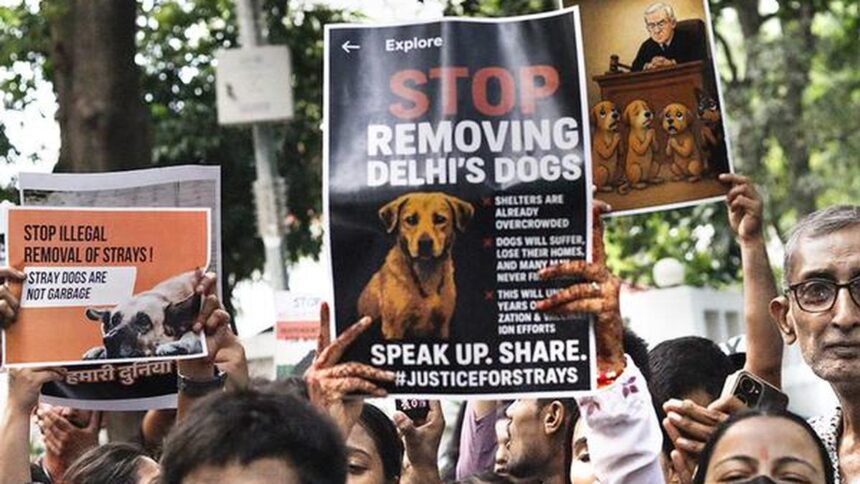
Supreme Court Reserves Order on Plea Against Stray Dogs Removal in Delhi-NCR
The ongoing legal battle over the removal of stray dogs from the streets of Delhi-NCR reached a crucial stage as the Supreme Court of India reserved its order on a plea challenging the practice. The matter, which has drawn national attention, pits municipal policies against animal welfare concerns, raising deeper questions about the balance between public safety and compassion for community animals. The bench, presided over by Justice Sanjiv Khanna and Justice Dipankar Datta, heard arguments from multiple parties, including petitioner counsel, interveners representing animal rights groups, and government agencies responsible for urban management.
During the proceedings, the apex court made it clear that the issue at hand was not merely a matter of street sanitation or local governance, but one that intersected with fundamental rights, ethical obligations, and judicial precedents. The bench noted that while civic bodies have a duty to ensure public safety, they must also adhere to laws and guidelines that protect animals from cruelty. This dual responsibility has often resulted in legal and administrative friction, as witnessed in the present case.
The petitioner’s argument was rooted in the claim that indiscriminate removal of stray dogs violates provisions of the Prevention of Cruelty to Animals Act, 1960, and runs contrary to the Animal Birth Control (Dogs) Rules, 2023, which mandate sterilisation, vaccination, and return of dogs to their original location. According to the plea, removal without due process amounts to both a legal violation and an ethical failure, especially when many of these animals are sterilised and pose minimal threat.
Representatives for the interveners echoed these concerns, stressing that the concept of “removal” often leads to unlawful relocation or even euthanasia, despite clear guidelines prohibiting such actions except in cases of incurable disease or extreme aggression. They argued that the issue was not one of animal overpopulation alone but of poor implementation of existing welfare schemes. Furthermore, they pointed out that scientific studies indicate community dogs play an ecological role in controlling rodent populations and providing a form of territorial security.
On the other side, counsel for municipal bodies in Delhi-NCR presented a different reality — one marked by repeated citizen complaints, instances of unprovoked dog bites, and rising public frustration over perceived inaction. They maintained that their primary duty was to safeguard human life and ensure public spaces remained safe and hygienic. For them, controlled removal, when done in accordance with law, was not cruelty but a necessary measure to address an urgent civic concern.
The Supreme Court bench adopted a measured tone during the exchanges, cautioning all parties against framing the matter in extreme terms. Justice Khanna observed that both unrestrained hostility towards stray animals and uncritical romanticisation of their presence could lead to flawed policy decisions. The court hinted at the possibility of issuing a set of clarifying directions that could standardise the approach across municipal bodies, ensuring that both public safety and animal welfare principles are upheld.
The reservation of the order indicates that the bench will deliberate extensively before issuing a ruling that could have far-reaching implications for how Indian cities deal with community animals. This is not the first time the Supreme Court has had to navigate this contentious territory. Previous cases, such as Animal Welfare Board of India vs. A. Nagaraja, have established important jurisprudence around the rights of animals and the responsibilities of humans in ensuring their well-being. The present matter builds on that foundation but also confronts the urgent pressures of urban population growth and rising public intolerance towards street dogs.
For animal rights advocates, the court’s forthcoming decision could reaffirm legal safeguards and force municipalities to invest in systematic sterilisation and vaccination programs instead of opting for quick fixes. For municipal authorities and residents concerned about safety, it could lay down clearer legal boundaries for intervention while ensuring that genuine cases of threat are addressed swiftly and lawfully.
Legal Precedents and the Broader Context of Stray Dog Management in India
The question of how Indian cities manage stray dog populations has been legally contentious for decades, with the Supreme Court and various High Courts repeatedly called upon to draw a balance between municipal duties and animal welfare mandates. The roots of this conflict trace back to the early 2000s when the Animal Birth Control (Dogs) Rules were first notified under the Prevention of Cruelty to Animals Act, 1960. These rules introduced a structured approach: stray dogs were to be captured, sterilised, vaccinated, and then returned to their original location. The rationale was both humane and practical — a sterilised and vaccinated street dog is less aggressive, poses fewer public health risks, and naturally keeps unsterilised dogs from occupying the same territory.
However, the implementation of these rules has been uneven. In some cities, sterilisation drives have been consistent and well-funded; in others, they have been sporadic, under-resourced, or even ignored. This lack of uniformity has given rise to public frustration, especially in urban areas with dense human and canine populations. Courts have frequently intervened to address complaints from both ends of the spectrum — from residents demanding mass removal of dogs to activists seeking protection for every community animal. Each judgment has added a layer of complexity to the evolving legal landscape.
One landmark intervention came in Animal Welfare Board of India vs. People for Elimination of Stray Troubles (2016), where the Supreme Court temporarily stayed orders from certain municipal corporations that had called for mass culling of stray dogs. The Court emphasised that public safety concerns must be addressed within the framework of existing laws and humane practices. This principle has since become a cornerstone in judicial reasoning on the matter: the State’s power to act is not unfettered; it is bounded by statutory obligations and constitutional principles.
Equally significant is the recognition of animals as sentient beings in Indian jurisprudence. In Animal Welfare Board of India vs. A. Nagaraja (2014), while dealing with the ban on the bull-taming sport of Jallikattu, the Supreme Court affirmed that animals have a right to live with dignity, free from unnecessary pain and suffering. Though the case was not directly about stray dogs, its philosophical underpinnings have influenced subsequent decisions, framing animal welfare as a constitutional value rather than a discretionary act of kindness.
The current plea before the Supreme Court concerning Delhi-NCR must therefore be read against this backdrop of established legal principles. If the Court chooses to reinforce the ABC Rules’ primacy, municipal bodies will be compelled to recalibrate their approach, focusing on sustained sterilisation and vaccination rather than ad-hoc removals. However, this will also require significant budget allocations, trained manpower, and public cooperation — factors that have historically posed challenges.
From a governance perspective, the stray dog issue in India has often been treated as a reactive problem rather than a preventive one. Typically, municipal action intensifies following public outcry over high-profile dog bite incidents. Media coverage in such cases is intense, often portraying stray dogs as dangerous and unmanageable. This fuels public demand for immediate removal, creating political pressure on civic authorities. In contrast, long-term sterilisation and vaccination programs, though more effective, do not generate quick visible results and therefore receive less political attention.
Social perceptions add another layer of complexity. In many Indian neighbourhoods, residents have informal relationships with community dogs — feeding them, naming them, and even protecting them from municipal capture. Such bonds can turn confrontational when removal teams arrive, leading to street-level disputes between officials and locals. Conversely, in areas where dogs are seen solely as a threat, residents may actively obstruct welfare volunteers, viewing their interventions as contrary to public safety.
Public health concerns cannot be ignored in this debate. Rabies remains a serious threat in India, claiming hundreds of lives annually. The World Health Organization recommends a combined strategy of mass dog vaccination and public awareness campaigns to eliminate rabies. Yet, in practice, municipal bodies often focus disproportionately on physical removal of dogs without addressing the root causes of disease transmission. Without vaccination, removal merely shifts the problem to another area — a cycle that benefits neither people nor animals.
Against this complex backdrop, the Supreme Court’s reserved order has the potential to become a turning point. If the judgment manages to reconcile public safety with animal welfare in clear, implementable terms, it could serve as a template for other cities grappling with the same issue. Such a decision would need to address not only the legal dimensions but also the administrative and social realities of urban India.
The Delhi-NCR Context: Population Density, Urban Design, and the Stray Dog Equation
Delhi-NCR presents a particularly complex stage for the stray dog debate because it is not a single city operating under a uniform administrative framework. Instead, it is a sprawling urban agglomeration spread across multiple jurisdictions — including the Delhi municipal corporations, the New Delhi Municipal Council (NDMC), the Delhi Cantonment Board, and municipal bodies in adjoining states such as Haryana and Uttar Pradesh. This fragmented governance structure creates inconsistencies in both policy design and its execution.
For example, the sterilisation drive in South Delhi may follow a relatively organised schedule with designated contractors and veterinary teams, while in neighbouring Gurugram, municipal priorities may be skewed toward infrastructural projects, leaving animal birth control on the sidelines. In Noida, which falls under the jurisdiction of the Noida Authority, there are periods when sterilisation activities slow to a near halt due to budgetary reallocations or tender delays. These differences matter because stray dogs do not recognise municipal boundaries — their movements are dictated by access to food, water, and shelter, which often means crossing into multiple jurisdictions in a single day.
Population density exacerbates the challenge. Delhi is one of the most densely populated cities in India, with over 11,000 people per square kilometre in certain wards. Public spaces are scarce, and the contest for them is intense. Stray dogs, as territorial animals, occupy specific areas — markets, housing colonies, bus stops — which also happen to be high footfall zones for humans. This naturally increases the frequency of human-dog encounters, and by extension, the potential for conflict.
Urban design has played an underrated role in shaping the stray dog issue. Many residential colonies have open garbage points, poorly managed waste collection systems, and abundant food waste from roadside eateries. These create permanent food sources for stray dogs, sustaining their populations and encouraging them to remain in human-dense areas. Attempts to relocate dogs from such locations often fail because the same conditions attract new dogs within weeks. Without a parallel effort to address waste management, sterilisation programs alone cannot yield lasting results.
The socio-economic diversity of Delhi-NCR further complicates the picture. In affluent gated communities, residents may be more inclined to hire private security to keep stray dogs off their premises. However, in informal settlements and lower-income areas, community dogs are often seen as valuable allies in guarding against petty theft. This cultural acceptance can act as a natural protective buffer for stray dogs in some regions while leading to targeted removal efforts in others.
Political dynamics cannot be ignored either. The municipal corporations in Delhi have frequently been at odds with the state government over funding and administrative control. Animal welfare programs often become collateral damage in these disputes, suffering delays or budget cuts when political priorities shift. In NCR cities like Gurugram or Faridabad, where municipal bodies are under state government control, decisions about dog management are influenced by local political considerations, including upcoming elections or public sentiment in key constituencies.
Media narratives amplify these tensions. A single high-profile dog bite incident in a school or public park can dominate headlines for days, leading to public outrage and demands for swift action. Politicians and civic officials often respond to this pressure with highly visible measures, such as large-scale capture operations, which may temporarily appease public anger but do little to address underlying causes. Conversely, stories of cruelty toward stray dogs trigger equally strong backlash from animal welfare groups, creating a polarised environment where middle-ground solutions receive little attention.
One of the under-discussed realities is that accurate data on the stray dog population in Delhi-NCR is scarce. Estimates vary widely, with some NGOs claiming there are over 6 lakh stray dogs in Delhi alone, while municipal figures are significantly lower. This lack of reliable baseline data makes it difficult to measure progress or design targeted interventions. Without knowing how many dogs exist, where they are concentrated, and what proportion is already sterilised or vaccinated, policymaking becomes a matter of guesswork.
In this environment, the Supreme Court’s impending judgment could act as a catalyst for a more coordinated approach. If the Court mandates strict adherence to the Animal Birth Control Rules across all NCR jurisdictions, it could push municipal bodies to work collaboratively, share resources, and maintain a centralised database of sterilisation and vaccination records. However, this would also require significant political will and inter-agency cooperation — commodities that are often in short supply in India’s administrative culture.
Public Health Concerns: Rabies, Bite Incidents, and Community Safety
When discussing stray dog management in Delhi-NCR, public health inevitably becomes the most urgent point of conversation. The fear surrounding dog bites is not merely about physical injury — it is deeply tied to the threat of rabies, a disease that remains almost uniformly fatal once symptoms appear. While India has made progress in reducing human rabies deaths over the last two decades, it still accounts for an estimated one-third of the world’s rabies fatalities, according to World Health Organization (WHO) data.
Delhi, being a densely populated urban hub, is particularly vulnerable. Thousands of dog bite cases are reported annually across government hospitals, private clinics, and municipal records, but experts agree the true figure is likely much higher due to underreporting. Many minor bites or scratches never reach official registers, especially in low-income settlements where residents may not have immediate access to healthcare or may dismiss the need for treatment.
Rabies prevention hinges on two parallel efforts: vaccinating dogs and ensuring timely post-exposure treatment for humans. In theory, mass dog vaccination campaigns should be the first line of defence, as WHO recommends vaccinating at least 70% of the dog population to break the rabies transmission cycle. However, in Delhi-NCR, inconsistent sterilisation drives often include vaccination, but not at the scale or frequency required to meet this threshold. Compounding the issue, many captured dogs are released back into the same area without visible identification (such as coloured ear tags or microchips), making it difficult to track vaccination coverage.
Human treatment also has its bottlenecks. While major hospitals in Delhi have rabies vaccines and immunoglobulin in stock, smaller clinics, especially in peri-urban NCR areas, may experience shortages. The cost of rabies immunoglobulin — the life-saving component in severe exposure cases — remains prohibitive for many private patients, leading some to skip doses. Even when vaccines are available, awareness about the need for immediate treatment is uneven, with myths and misinformation still circulating in several communities.
Dog bite incidents also trigger a psychological impact that extends beyond the individual victim. In many neighbourhoods, especially those with children and elderly residents, a single serious bite case can lead to a collective shift in behaviour — fewer outdoor evening activities, increased use of private security in colonies, or even informal vigilante-style measures to remove or harm dogs. This atmosphere of fear can erode trust between residents and animal welfare advocates, making cooperative management harder.
The challenge is further intensified by the high turnover rate of Delhi’s stray dog population. Even with sterilisation efforts, gaps in the program mean that new litters are born every season. Puppies often receive attention and feeding from compassionate locals, but if they are not vaccinated early, they can become vectors for rabies in the future. Without a sustained, year-round public health strategy that links sterilisation, vaccination, and community education, these cycles will repeat.
International best practices offer some useful guidance. Cities like Istanbul and Bangkok have achieved notable reductions in street dog-related health risks without resorting to mass culling. The key has been community engagement — training local feeders to participate in vaccination drives, creating mobile vet units for on-the-spot treatment, and using technology to map and monitor dog populations. In India, a few pilot projects have attempted similar approaches, such as geo-tagging sterilised dogs or using mobile apps for bite reporting, but scaling these initiatives in a region as vast and diverse as Delhi-NCR remains a formidable task.
The Supreme Court’s decision could set a precedent by requiring municipal bodies to integrate public health metrics into their dog management policies. This would mean measuring success not only in terms of the number of dogs relocated or sterilised, but also through reductions in bite incidents, rabies prevalence, and public complaints. Such a shift would transform the debate from one of confrontation — humans versus dogs — into one of measurable, sustainable safety for both.
Also Read : Indian Economy Under Strain as Trump’s Tariffs Put Modi Between a Rock and a Hard Place