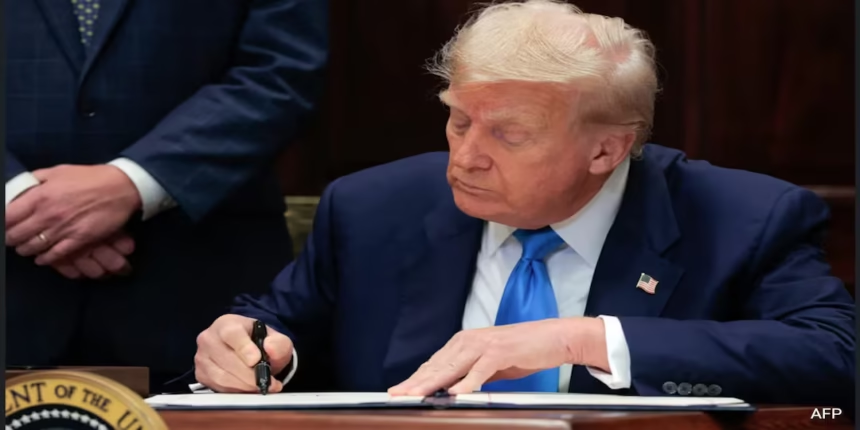
The Announcement that Shook the Global Trade Table
In a move that sent shockwaves through international trade corridors, former U.S. President Donald Trump announced a 25% tariff on all Indian goods entering the United States, coupled with an additional penalty for India’s continued oil trade with Russia. The announcement, made during a campaign-style rally and simultaneously posted across social media platforms, reignited long-standing tensions over trade imbalances and geopolitical alignments.
Trump, known for his protectionist policies during his presidency, accused India of taking unfair advantage of the United States’ market and failing to reduce its dependency on what he called “America’s strategic adversaries.” The 25% tariff, set to come into effect on August 1, 2025, marks one of the most dramatic shifts in Indo-U.S. trade relations in recent memory.
The penalty regarding India’s oil purchases from Russia comes in the backdrop of heightened Western sanctions on Moscow following its sustained military campaigns and strained global diplomacy. Trump’s statement made clear that continued economic engagement with Russia would come at a price for countries that consider themselves allies of the U.S.
The announcement was met with a wave of uncertainty and criticism from international economists, Indian government officials, and global trade analysts. Many viewed the move as a political maneuver targeting India’s strategic autonomy and growing economic stature in the Global South.
India’s Response: Strategic, Measured, and Sovereign
India’s Ministry of External Affairs responded swiftly, calling the tariffs and penalties “unwarranted, unilateral, and inconsistent with international trade norms.” The statement emphasized India’s commitment to a rules-based international order and warned that retaliatory steps could be considered if discussions failed to yield a constructive outcome.
High-level meetings were convened in New Delhi as policymakers scrambled to assess the full scope of economic consequences. The Confederation of Indian Industry (CII) and the Federation of Indian Export Organisations (FIEO) jointly urged the government to adopt a mix of diplomatic dialogue and trade countermeasures to protect Indian exporters.
At the same time, Indian oil authorities maintained that energy security and strategic interests would remain paramount. Officials highlighted that India’s energy mix requires diverse sources, and decisions on oil imports are guided by national interest, not external pressure.
The ruling party, while not escalating the matter in overtly aggressive terms, positioned the tariff imposition as a test of India’s economic resilience and geopolitical maturity. Meanwhile, opposition leaders criticized the government for failing to preempt the fallout and called for urgent remedial action.
Market Ripples and Investor Reaction
Financial markets in both countries reacted sharply. The Indian stock market opened lower the morning after the announcement, with shares of export-heavy industries such as textiles, pharmaceuticals, and IT services taking a significant hit. The rupee also faced immediate downward pressure, although the Reserve Bank of India moved quickly to stabilize the currency.
U.S.-based multinational companies with a footprint in India expressed concern over possible retaliatory measures and the longer-term impact on supply chains. American investors, particularly those engaged in technology and services outsourcing, called for urgent policy engagement to prevent escalation.
Global commodities markets also experienced fluctuations, especially in crude oil, given the added tension around India’s oil imports from Russia. Analysts warned that further penalties or trade restrictions could increase volatility in an already fragile global economic environment.
Diplomatic Channels and the Road to Negotiation
As tensions mounted, diplomatic backchannels were activated at full throttle. The Indian Ambassador to the U.S. held urgent consultations with senior officials at the U.S. Department of State and the Office of the United States Trade Representative (USTR). Meanwhile, India’s National Security Advisor held talks with counterparts in Washington to assess the broader implications for strategic ties.
Simultaneously, efforts were underway to convene a virtual summit between Indian Prime Minister Narendra Modi and former President Trump, who continues to wield significant influence over the Republican party and U.S. foreign policy narrative. Sources within the Ministry of External Affairs suggested that India would push for a rollback or at least a deferment of the tariff implementation deadline.
Think tanks and policy institutes on both sides of the Atlantic began publishing rapid assessments. The Council on Foreign Relations (CFR) and Observer Research Foundation (ORF) released joint position papers urging dialogue over confrontation. They emphasized the need to preserve the economic and strategic partnership that has evolved between the two democracies over the past two decades.
Public sentiment in India also began to shift. While many viewed the tariffs as unjustified, there was a growing recognition of the need for India to diversify its export base and reduce its dependency on any single market. Influential business leaders started calling for deeper engagement with ASEAN, Africa, and Latin American economies as alternative growth vectors.
Back in Washington, Trump’s announcement had already begun to stir divisions within political circles. While hardline nationalists supported the move as a stand against global trade “injustice,” moderates within the Republican Party expressed concern about alienating a key democratic ally in Asia, especially as China’s influence continued to grow.
The road to negotiation was uncertain, but both nations understood that letting the crisis spiral unchecked could harm not only bilateral trade but also the fragile geopolitical balance in Asia-Pacific. Over the next few weeks, intense lobbying, diplomatic maneuvering, and public messaging were expected to play critical roles in shaping the final outcome.
Domestic Political Fallout in the U.S. and India
The tariff shockwave did not remain confined to international trade circles; it quickly reverberated through the domestic political arenas of both the United States and India. In Washington, the announcement triggered fiery debates on Capitol Hill. While Donald Trump’s core base welcomed the move as another bold strike against what they perceived as unfair trade practices, many lawmakers from both parties expressed deep reservations.
Moderate Republicans, particularly those from states with strong export ties to India—such as California, Texas, and New York—warned of unintended consequences. “This is a self-inflicted wound,” remarked Senator Lisa Mathews, a Republican from Texas, during a televised session of the Senate Foreign Relations Committee. “We risk alienating a critical ally and undermining U.S. businesses invested in Indian markets.”
Democratic lawmakers, already critical of Trump’s prior trade wars, seized the opportunity to paint the tariffs as reckless and politically motivated. Several prominent Democrats highlighted how the move might strain broader Indo-U.S. cooperation in defense, climate change, and technology exchange. “This isn’t just about trade—it’s about strategic alignment in the Indo-Pacific,” warned Senator Andrew Callahan, a member of the Senate Armed Services Committee.
Back in India, the political temperature also rose. The ruling Bharatiya Janata Party (BJP) defended its handling of the crisis by highlighting its rapid diplomatic response and refusal to be coerced into altering its independent energy policy. Prime Minister Modi, in a nationally televised address, reaffirmed India’s commitment to sovereignty and dignity in international relations. “India will not bow to pressure,” he declared, “but we remain open to fair dialogue and mutual understanding.”
The opposition, led by the Indian National Congress and several regional parties, saw an opening to criticize what they described as “weak anticipation and overconfidence in foreign policy.” Congress leader Rahul Gandhi accused the Modi government of prioritizing optics over strategy. “The government was caught napping,” he said at a press conference. “We need stronger economic foresight and less headline management.”
Meanwhile, think tanks in New Delhi hosted back-to-back panels dissecting the political dimensions of the tariffs. The Centre for Policy Alternatives (CPA) released a report predicting that India’s rural manufacturing sectors—particularly in Uttar Pradesh, Tamil Nadu, and Gujarat—could face immediate losses due to reduced U.S. orders.
For India’s middle class, the issue hit close to home. With many families dependent on jobs in export-driven sectors such as IT, textiles, and pharmaceuticals, there was growing anxiety about job security and wage stagnation. Similarly, in the United States, consumer advocacy groups warned that the tariffs could lead to higher prices for essential goods sourced from India, ranging from generic medicines to household items.
In both countries, the business community played a pivotal role in shaping the political discourse. CEOs of major Indian firms—such as Infosys, Reliance, and Tata Consultancy Services—met with senior Indian ministers to strategize response plans. At the same time, major U.S. corporations with ties to India, including Amazon, Google, and General Electric, began lobbying Congress and the Biden administration to intervene and temper the fallout.
One of the more unexpected outcomes was the emergence of a bipartisan Indo-American Congressional Caucus that began advocating for a reset in tone and trajectory. Comprised of lawmakers of Indian origin and other strategic thinkers, the group issued a resolution urging both sides to “resolve disagreements through diplomacy, not disruption.”
The tariff announcement also led to renewed debates about the need for a long-term Indo-U.S. Free Trade Agreement (FTA). Though discussions on an FTA have been sporadic for over a decade, the present crisis rekindled interest in institutionalizing trade norms rather than relying on political whims.
In essence, the domestic political impact of Trump’s tariff decision extended far beyond the economic graphs. It stirred questions of leadership, foresight, and national interest in both nations, offering a rare window into how deeply trade decisions are intertwined with the political pulse of modern democracies.
The Trump tariffs reignited fierce political debate within India, exposing ideological rifts between major parties and igniting a storm in the ongoing parliamentary session. Members of the ruling Bharatiya Janata Party (BJP) rallied around the government’s diplomatic and legal strategy, portraying it as a defense of national pride and economic sovereignty.
Prime Minister Modi addressed the nation through a televised speech, stating, “India will never compromise on its sovereign right to trade with whom it chooses. We will stand firm against any attempt to coerce our nation’s economic path.” The speech was widely broadcast and accompanied by coordinated messaging across social media platforms by BJP leaders.
In contrast, opposition parties accused the Modi government of mishandling the relationship with the United States and failing to foresee the escalation. Rahul Gandhi, leader of the Congress Party, criticized the government’s “over-personalized foreign policy” and claimed that lack of institutional depth in diplomacy had exposed Indian businesses to unnecessary harm.
Regional parties also joined the fray, with leaders from Tamil Nadu and West Bengal calling for greater autonomy in trade-related decisions affecting local industries. State governments sought special relief packages to support exporters impacted by the tariffs.
Media outlets mirrored the divided landscape. Right-leaning newspapers hailed Modi’s stance as decisive and patriotic, while liberal publications highlighted concerns about the economic toll and diplomatic missteps. Business dailies focused on the immediate implications for exporters and the potential long-term need for diversification.
On the ground, labor unions and small business associations organized peaceful protests, especially in industrial hubs like Surat, Ludhiana, and Tirupur. Exporters in these regions feared job losses and reduced global competitiveness due to higher entry costs in the American market.
As political tempers flared, the broader public appeared divided. Some viewed the crisis as a necessary assertion of Indian autonomy in a multipolar world. Others, however, questioned the wisdom of antagonizing a major trade partner at a time of global economic fragility. The issue had clearly moved beyond the realm of policy and into the national conscience, reflecting the intricate nexus between trade, politics, and public perception.
Also Read : F-35 Fighter Jet Crashes in California – $100M Stealth Aircraft Down, Pilot Ejects Safely