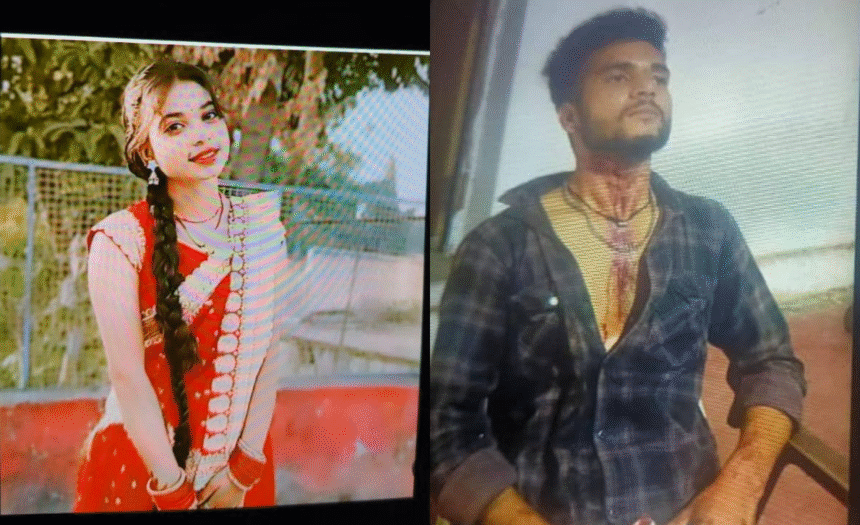
17-Year-Old Girl Killed in Madhya Pradesh Hospital: Man Restrains Her, Slits Throat in 30-Second Attack
Teen girl’s throat slit inside Madhya Pradesh hospital as attacker sat on her chest before killing her, in a horrifying security breach that raises serious questions about patient safety and hospital surveillance.
A Routine Day, A Final Visit
On June 27, 2025, 17-year-old Sandhya Chaudhary, a Class 12 student from Narsinghpur, Madhya Pradesh, left her home around 2 PM. She told her family she was going to visit a friend’s sister-in-law who had recently been admitted to the maternity wing of the Narsinghpur Government District Hospital. It was a casual, familiar setting — a routine visit in a familiar space. But within an hour, this visit would end in a brutal and shocking public murder that has since triggered national outrage, debates about institutional security, and soul-searching over societal apathy.
A Predator in Plain Sight
Unknown to Sandhya and her family, her alleged killer, 20-year-old Abhishek Koshti, had been loitering on the hospital premises since noon. CCTV and eyewitness accounts confirm his presence for at least two hours prior to the attack. Reports suggest that Abhishek was obsessed with Sandhya and had been stalking her for months. Whether any formal complaint was made remains unclear, but his behavior — persistent and predatory — had gone unchecked by local authorities.
On this day, as Sandhya entered the hospital, Abhishek reportedly spotted her near Room 22. The two exchanged a few words outside the emergency wing. Within minutes, their encounter turned confrontational. Eyewitnesses recall raised voices — a warning unheeded.
A Hospital Becomes a Crime Scene
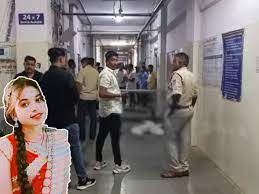
The emergency ward, meant to be a zone of urgent care and professional alertness, instead turned into a theatre of violence and helplessness. A video recorded by a bystander’s mobile phone later surfaced online. It shows the full horror: Abhishek slaps Sandhya, throws her down, pins her by sitting on her chest, and brutally slits her throat with a knife. All of this occurs under full artificial lighting, in a hospital filled with doctors, nurses, security personnel, and patients.
No one intervenes.
In the footage, some staff members can be seen walking past. Others look on, seemingly frozen by fear or apathy. No alarm is raised. No attempt is made to stop the attack or render immediate aid. The violence lasts over 10 minutes. Blood pools beneath Sandhya. She dies on the spot.
The Aftermath — Silence, Shock, and Flight
After committing the murder, Abhishek attempts to slit his own throat. He fails. Instead of being detained, he simply flees the scene. He walks out of the trauma ward, exits the hospital, starts a bike parked outside, and rides away.
This effortless escape raises disturbing questions. Two guards were reportedly posted at the trauma center’s entrance. Inside, a duty doctor, nursing staff, and ward boys were all present. No one physically tried to stop the attacker. No emergency protocol appears to have been triggered. The ease with which Abhishek escaped compounds the horror of the crime itself.
A Family Shattered, a Community in Rage
Sandhya’s family was informed of her death around 3:30 PM. When they arrived at the hospital, her body was still lying at the site of the attack, unattended. Shock turned to grief. Grief turned to rage. By 5 PM, the family and hundreds of supporters began protesting outside the hospital gates, blocking the main road.
The protest swelled as evening turned to night. Police and local officials struggled to contain public anger. Finally, by 2 AM, the crowd dispersed after district authorities promised strict action against those responsible for the security lapse.
The trauma ward, meanwhile, had emptied. Of the 11 patients admitted earlier that day, eight requested discharge immediately. The remaining three left the next morning. The fear was palpable. Trust in the hospital — as a place of safety — had been irrevocably shattered.
Media Frenzy and Political Reactions
As footage of the killing surfaced online, national media descended on Narsinghpur. Social media exploded with outrage, triggering debates about women’s safety, stalking, public apathy, and institutional collapse. Political leaders across the spectrum issued statements, some expressing grief, others demanding accountability.
The state government ordered an inquiry. The hospital administration claimed ignorance of the attacker’s presence. The district police launched a manhunt for Abhishek Koshti.
But the questions remained: How could such a crime occur in full public view? Why did no one act? And why did a place meant to heal turn into a site of murder?
A Nation of Spectators — The Normalisation of Violence in Public Spaces
The killing of Sandhya Chaudhary did not occur in an isolated alley or during the dead of night. It happened in a well-lit public hospital during daylight hours, in front of staff, patients, and visitors. This detail is what distinguishes it from countless other gender-based crimes — not only the brutality, but the public indifference.
India has witnessed several high-profile cases of bystander inaction. From the 2012 Delhi gang rape to the recent Kanpur road accident where a man was left to die as cars passed by, the pattern is disturbingly consistent: we are a nation that watches.
Sociologists describe this as the ‘bystander effect’ — a psychological phenomenon where individuals fail to help victims in the presence of others, believing someone else will act. In India, this is compounded by fear of police entanglement, lack of faith in institutions, and, increasingly, the normalisation of violence as just another part of everyday life.
The Hospital’s Security Void — A System Built to Fail
Narsinghpur’s district hospital, like many government-run facilities across India, suffers from chronic understaffing, overburdened staff, lax surveillance systems, and inadequate security training. On the day of the murder, there were reportedly two guards posted at the trauma ward and five CCTV cameras functioning within the hospital.
Yet none of these mechanisms worked. No guard intervened. No staff pressed a panic button. No one locked the door or attempted to isolate the attacker. In post-incident reports, it was revealed that no formal emergency response drill had ever been conducted at the facility.
The failure wasn’t one of the moment. It was structural — years in the making.

The Role of the Police — Delayed Action and Reactive Governance
After Abhishek Koshti fled the crime scene, it took law enforcement over 12 hours to locate and arrest him. He was found hiding at a relative’s house. The police claimed he had attempted suicide again and was under observation.
But the delay is telling. Despite a viral video, widespread identification, and media pressure, the arrest was not immediate. This suggests gaps in coordination, preparedness, and urgency. Once again, the system was not equipped to respond to a violent act, even when it occurred within the public domain.
Additionally, the police admitted that Koshti had a history of stalking Sandhya. Yet no prior warnings were issued. No legal restraining orders existed. The system had failed to even acknowledge the warning signs.
Women’s Safety Beyond Slogans — A Culture of Disregard
India has, in recent years, launched various schemes aimed at improving women’s safety — from panic button-enabled mobile apps to emergency helplines and Nirbhaya Funds for public infrastructure. Yet, in moments of crisis, these mechanisms frequently fail.
There is a yawning gap between policy and reality. The promise of safety rarely reaches the last mile — the small-town trauma ward, the understaffed police station, the teenage girl simply visiting a friend.
In Sandhya’s case, no safety protocol came to her aid. No law enforcement officer preemptively acted on the red flags. No civil servant took responsibility for post-mortem negligence.
Institutional Impunity — Who Gets Held Accountable?
Following the public outcry, the Madhya Pradesh government suspended several hospital staff members and ordered a magisterial inquiry. But will that be enough?
Historically, such inquiries result in paperwork, not punishment. Temporary suspensions get overturned. The attention fades. The cycle resets.
True accountability would require systemic overhauls — investment in hospital security, mandatory emergency training, legal protections for whistleblowers, and a cultural shift in how public spaces are policed and perceived.
But systemic reform is slow. In the interim, people continue to die.
A Mirror to Society — What the Sandhya Case Reveals About Us
The Sandhya Chaudhary case is not merely a crime story. It is a social diagnosis. It shows how a country that has normalised gender violence, disempowered its public institutions, and numbed its citizenry now risks becoming unshockable.
It also reflects the failure of communal responsibility. We are not simply governed poorly — we are bystanders to our own decline.
Until we interrogate our instinct to spectate rather than intervene, until we hold systems accountable not just in headlines but through reform, until we prioritise empathy over apathy — the next Sandhya is only a matter of time.
A Town in Uproar — Candlelight Vigils and Civil Rage
Within 48 hours of Sandhya’s murder, Narsinghpur transformed from a quiet town into the epicenter of a national conversation on institutional apathy and gendered violence. Local residents, student unions, and women’s rights groups held candlelight vigils across the town. Hundreds marched to the District Collector’s office demanding answers. Hashtags like #JusticeForSandhya and #NarsinghpurHorror began trending on social media platforms.
The family, grieving but determined, emerged as the voice of the movement. Sandhya’s father vowed not to cremate his daughter until formal murder charges and criminal negligence proceedings were registered against hospital staff.
Political Engagement and Institutional Resistance
Political parties — both ruling and opposition — quickly jumped into the fray. Delegations from the state women’s commission visited Narsinghpur. Members of Parliament and MLAs issued strongly worded statements. Some promised compensation. Others demanded that the Home Ministry intervene.
Yet, despite the attention, there was pushback. Hospital officials resisted criminal inquiries, citing ‘lack of intent’ and procedural ambiguity. District authorities offered symbolic gestures — a plaque in Sandhya’s name, increased CCTV funding — but skirted direct accountability.
Activists and legal scholars warned that justice was already being negotiated away in bureaucratic grey zones.
The Role of the Courts — PILs and Preventive Jurisprudence
Public Interest Litigations (PILs) began surfacing in Madhya Pradesh High Court. NGOs like Nirbhaya Jyoti Foundation and Human Rights India filed urgent pleas seeking:
- Mandatory panic buttons and rapid response teams in all government hospitals
- Gender-sensitization training for hospital staff
- Real-time tracking of previously accused stalkers under restraining orders
The judiciary, in preliminary hearings, expressed strong dissatisfaction with the police report. A suo motu notice was issued to the Health Department, demanding a detailed breakdown of their safety protocols.
Legal experts noted that Sandhya’s case might become a watershed moment for embedding safety-by-design in public health infrastructure.
Sandhya as Symbol — From Victim to National Reckoning
Sandhya’s image — smiling in her school uniform — became a symbol. Posters were printed with her name, not just in Madhya Pradesh but across India. In Delhi, Mumbai, Lucknow, and Bhopal, students organised solidarity marches.
Her story cut across caste, class, and geography. Because she was not just a “victim” — she was a teenager doing something ordinary, made extraordinary only by the brutality of her end.
Journalists, columnists, and social commentators began framing her case alongside India’s worst gender crimes. But more importantly, ordinary citizens began asking: could this have happened to someone I know? Could this have been my daughter?
The Gendered Architecture of Public Space
Urban planners, sociologists, and architects joined the conversation, pointing to how public buildings — especially in small towns — are rarely designed with safety in mind. Dim lighting, unsupervised corridors, no emergency exits, and absence of alert systems make such spaces breeding grounds for vulnerability.
The Narsinghpur hospital, like many across India, had zero provisions for emergency lockdowns, no intercom announcements, and no female security personnel on duty. It wasn’t just Sandhya who was failed — it was every woman who walks into a government institution assuming basic protection.

Collective Grief as Catalyst
In the days following Sandhya’s funeral, community groups began converting grief into activism. Memorial scholarships were announced in her name. Street plays were performed in colleges across Madhya Pradesh narrating her story. Petition drives began, demanding structural reforms in all public hospitals.
A movement had begun — not just against one murderer, but against a system that made the murder possible.
Whistleblowers Silenced — Staff Under Threat
In the weeks following Sandhya Chaudhary’s murder, several junior hospital employees and nursing staff anonymously revealed procedural lapses that had gone unreported for years. They spoke of missing CCTV backups, untrained guards hired through third-party contractors, and a culture of silence where raising safety concerns was considered insubordination.
Two nurses who attempted to speak to the media were immediately transferred to rural dispensaries without explanation. A hospital clerk who testified to the inquiry committee later reported being harassed by his supervisor and told to withdraw his statement.
These acts sent a chilling message — that institutional protection was not for the truth-tellers, but for those willing to shield the system.
Administrative Deflection — When Accountability is a Scapegoat
The district health officer issued a public apology but denied any prior knowledge of Abhishek Koshti’s presence in the hospital. The medical superintendent claimed that staff were “under pressure and untrained for such emergencies.”
Instead of structural reform, the administration resorted to performative reshuffling: suspensions without inquiry, committees without deadlines, and safety audits that amounted to nothing more than checklist formalism.
The entire episode followed a now-familiar pattern — a spectacle of action without intent.
Fear Among Protestors — Surveillance and Intimidation
Activists who organised the candlelight marches reported receiving phone calls from unknown numbers. Some found police outside their homes late at night, asking about their “intentions.” Journalists covering the protests faced increasing pressure to dilute their reporting.
A local youth group, Narsinghpur Nari Suraksha Samiti, which had been planning a district-wide protest, received a notice under Section 144 citing potential disturbance to public order. The same town that had allowed a murder in broad daylight was now actively policing dissent.
The Cost of Memory — Families Under Scrutiny
Sandhya’s family initially received strong public sympathy. But as they persisted in demanding action, the tone shifted. Anonymous slander began circulating on WhatsApp groups — claiming the family had “connections,” that they were “exaggerating the story for compensation.”
They were asked repeatedly by officials to “move on” for the sake of “public harmony.” A local councillor even offered them money to stop pursuing criminal charges against the hospital administration.
It became clear: in India, grief becomes inconvenient when it refuses to be silent.
A Fragile Solidarity — When Movements Fracture
Internal rifts began appearing within the protest coalition. Some groups wanted to focus on legal reform. Others prioritized symbolic memorialisation. A few members accepted political appointments, leading to allegations of co-optation.
This fragmentation was not accidental. Authorities had long mastered the art of divide and deflate — turning a unified voice for justice into a chorus of competing demands.
Even as Sandhya’s name remained on protest posters, the clarity of the movement began to blur.
Institutional Reform Delayed — Policy, But No Urgency
The Madhya Pradesh Health Ministry eventually announced a statewide “Safe Hospital Initiative.” It proposed biometric entry for visitors, 24×7 command centers, and GPS-tagged guards.
However, budgetary allocations remained unclear. No timeline was issued. Not a single hospital had implemented the reforms three months after the announcement.
Sandhya’s case had triggered a policy response — but without deadlines, enforcement, or public oversight, the initiative appeared destined for the same quiet graveyard of other forgotten reforms.
The Long Silence — Justice as a Delayed Ritual
By the end of three months, Sandhya Chaudhary’s murder had mostly vanished from national headlines. Legal proceedings against Abhishek Koshti had begun in a local court, but adjournments delayed any substantive hearings. Hospital officials, once suspended, were quietly reinstated or transferred.
No senior bureaucrat resigned. No minister faced questioning. What remained was paperwork — and a grieving family navigating a legal maze with no clear end in sight.
Justice, in India, is rarely denied outright. It is delayed into irrelevance.
Vigilant Communities — The Rise of Local Watch Groups
Despite institutional apathy, some good emerged. In Narsinghpur and nearby districts, community watch groups began forming. Retired teachers, local advocates, homemakers, and students took it upon themselves to audit their local hospitals, inspect emergency infrastructure, and report on unsafe conditions.
These initiatives were informal, even fragile. But they marked a shift: a new kind of civic vigilance, born not of trust in the system, but of distrust in its silence.
Memory as Resistance — Keeping Sandhya’s Name Alive
On the 100th day of Sandhya’s death, a memorial was held on the steps of the same hospital where she was murdered. It was attended by over 600 people. Her parents lit a diya next to a portrait of her in school uniform.
They did not speak much. But a banner hung behind them read: “Don’t Look Away.”
That simple phrase became a refrain — picked up in other towns, on posters, and at panel discussions. Activists printed bookmarks, notebooks, and murals with Sandhya’s story. Not to commodify her, but to remember her — as a symbol of what happens when we do look away.
Lessons Not Yet Learned
What the Sandhya Chaudhary case revealed — again — is that institutional cruelty in India is not always active. Often, it is passive. It is the inaction of guards, the apathy of staff, the absence of policy, and the coldness of law.
We live in systems designed to minimize accountability and deflect moral responsibility. Hospitals without emergency buttons. Schools without child protection officers. Cities without women’s safety audits. Deaths, like Sandhya’s, are not exceptions. They are the design.
What Do We Owe the Dead?
We owe them memory. We owe them vigilance. We owe them the truth — not buried in headlines or footnotes, but remembered in law and action.
Sandhya will not return. But the public, if stirred into sustained awareness, might prevent another Sandhya from being abandoned in plain sight.
A Final Note — The Burden We Share
This five-part chronicle is not merely about one case. It is about every girl walking into a hospital assuming safety. Every parent who sends their child to school believing they will return. Every citizen who believes public spaces are neutral zones.
The Sandhya Chaudhary case is a mirror — not just to a broken system, but to ourselves. And what it reflects is painful.
We may not have committed the crime. But if we continue to live without outrage, intervene without courage, or remember without action — then we are part of the silence that enabled it.
Sandhya’s name must not fade.
Also Read : Squid Game Season 3: Lee Jung-jae Reprises Role as Netflix Confirms New Korean Thriller Chapter