Nagaland Rain Havoc: 3 Dead, Flights Suspended, Floods Trigger Emergency Response Across State
Nagaland rain havoc leaves 3 dead as relentless downpours trigger floods and landslides; flight operations suspended and emergency response initiated across the state.
An Unexpected Monsoon Onslaught
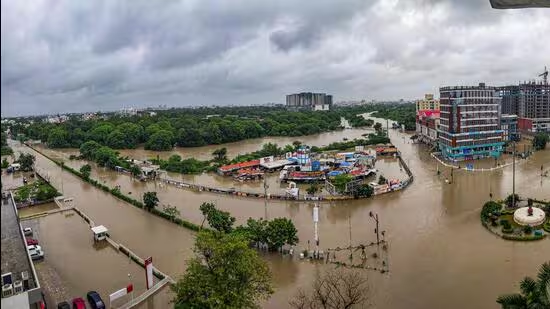
Nagaland, a small yet strategically significant state in Northeast India, has found itself grappling with a severe monsoon-induced flood crisis that has already claimed three lives, inundated urban centers, cut off critical highways, and suspended all flight operations in its only functional airport at Dimapur. As of the latest data, the state has received 393% more rainfall than normal within just 48 hours — marking a dangerous deviation from historical averages.
This part of the series explores the immediate human toll, flood damage to infrastructure, meteorological triggers, and the urgent response underway in what could be one of Nagaland’s worst rain emergencies of the past decade.
🔹 A Snapshot of the Disaster: 3 Dead, 70 Villages Hit, Flights Suspended
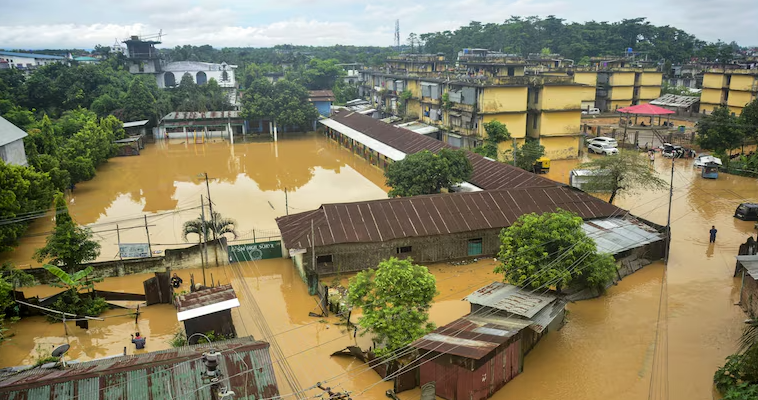
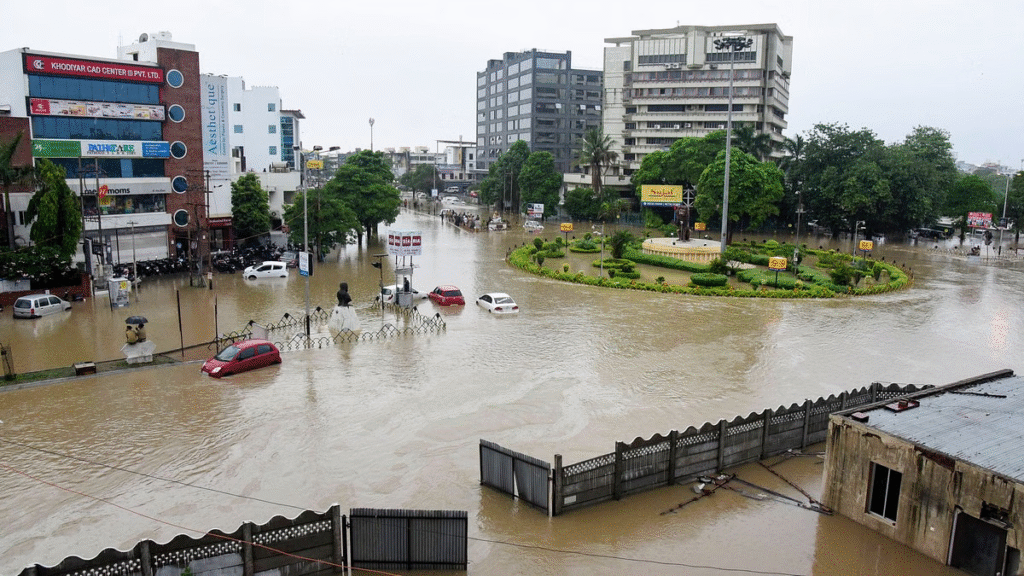
The most tragic consequence of the rainfall was recorded in Dimapur, where three residents — including a woman — were electrocuted inside their homes after floodwaters breached electrical systems. Videos and images from Half-Nagarjan locality showed residents wading through chest-deep water, with many forced to swim or use makeshift rafts to evacuate.
“We had no time to react. Water came in through the back and short-circuited everything. My uncle died holding a fan plug,” said a local survivor, refusing to be named.
Meanwhile, Dimapur Airport, the state’s only air connectivity point, was shut down completely on Sunday, with airlines like IndiGo and Air India Express cancelling all operations. Photos shared by airport authorities showed a submerged runway, apron, and adjacent aircraft parking zones.
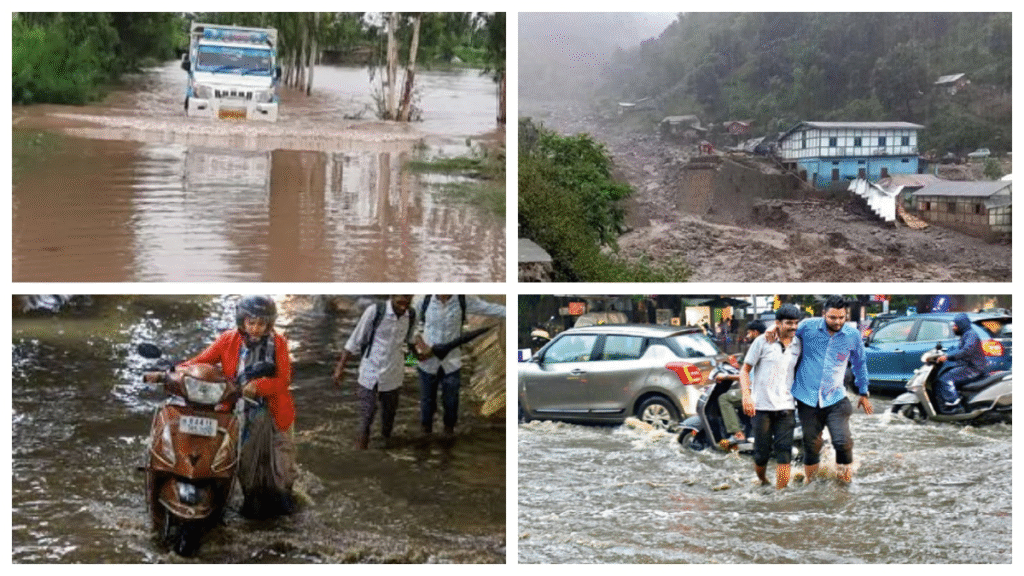
The National Highway 29, the arterial road that connects Dimapur to the capital Kohima, has been cut off by landslides at multiple points, creating transport chaos in both urban and rural districts.
🔹 Meteorological Red Alert: 393% Rainfall Spike Stuns Officials
According to official data from the India Meteorological Department (IMD) and Nagaland State Disaster Management Authority (NSDMA):
- Normal rainfall for early July is pegged at 10.1 mm,
- Recorded rainfall for July 5–6 stood at 49.8 mm,
- This means 393% excess rainfall across the state.
Some districts fared even worse:
- Kohima recorded 423% excess rainfall, making it one of the highest rainfall deviations in the Northeast,
- Dimapur and Niuland recorded the fastest urban flooding in recent memory, as per municipal officials.
What’s concerning is not just the volume but the rapidity of the downpour. Within six hours on July 6, nearly 70% of the total 48-hour rainfall fell, overwhelming:
- Drainage systems,
- Local ponds and lakes,
- Slopes vulnerable to mudslides and soil erosion.
Meteorologists attribute the sudden surge to a stalled low-pressure system over the Assam-Nagaland-Arunachal region, fed by Bay of Bengal moisture surges and strengthened by orographic lifting in the Naga hills.
🔹 Niuland: 70 Villages Underwater, Boats Become Lifelines
In Niuland district, 70 villages have been completely or partially submerged, according to field reports from block development officers and emergency staff.
- In Half-Nagarjan, the floodwaters rose up to three feet, damaging homes, schools, and cattle shelters.
- Emergency teams evacuated at least 52 people, including children and elderly, using inflatable boats and wooden rafts.
Dimapur’s Deputy Commissioner Dr Tinojongshi Chang stated to PTI:
“No fresh rain since last night has helped, and water is receding slowly. But we remain on high alert. Further showers could collapse the fragile banks.”
Local residents described a frightening night of water rushing in from rice paddies and low-lying plains, with many climbing onto rooftops to escape the flooding.
The district disaster control rooms are working overtime, fielding distress calls, and dispatching relief via water routes to cut-off areas.
🔹 National Highway 29 Blocked: Road to Kohima Cut Off
The Dimapur–Kohima National Highway (NH-29) is currently blocked at multiple points, including Piphema, Chumoukedima, and Seithekema, due to landslides.
Key impacts:
- Ambulance services have been halted in many villages,
- Goods supply to Kohima is disrupted,
- Emergency fuel supply to hilly areas is threatened.
The Border Roads Organisation (BRO) and state Public Works Department (PWD) teams are engaged in round-the-clock clearing, but officials warn that unstable slopes may delay full reopening by at least 48–72 hours.
🔹 Airport Closure and Urban Collapse in Dimapur
Flight cancellations at Dimapur Airport have caused ripple effects across:
- Medical referral cases to Guwahati,
- Emergency travel of stranded students and workers,
- Cargo air shipments of essential medical and relief materials.
The Airport Authority of India confirmed:
“All operations remain suspended until water is fully drained and electrical systems are safe. Runway inspections are ongoing.”
This also raises concerns about the infrastructure vulnerability of Northeast airports, many of which sit in floodplains or low-lying valleys, prone to waterlogging without adequate urban drainage.
🔹 State Response: NSDMA, Fire Services, and NDRF On Alert
The Nagaland State Disaster Management Authority (NSDMA) has:
- Set up 24×7 emergency control rooms in Kohima and Dimapur,
- Dispatched NDRF and Fire Services to high-risk zones,
- Created evacuation shelters in 9 districts,
- Launched a WhatsApp SOS line for flood-hit citizens.
Chief Minister Neiphiu Rio held an emergency briefing with the Chief Secretary and Home Commissioner, directing the administration to ensure:
- Availability of food, water, and medicine in shelters,
- Restoration of NH-29 and airport within priority timelines,
- Daily updates to the public via official bulletins.
🔹 A State Submerged, A System Tested
The deluge of July 5–6 has turned Nagaland into a flashpoint of climate volatility, exposing not just its physical vulnerability to floods and landslides, but also the fragility of its transport, aviation, and emergency preparedness systems.
As the rainfall shows signs of pause, the next 48 hours will determine whether the state can restore mobility, protect displaced populations, and prepare for another possible cloudburst, which meteorologists haven’t ruled out.
What’s clear is that this isn’t just a disaster. It’s a climate alarm for the entire Northeast.
🔹Infrastructure Collapse: Roads, Bridges, and Communication Lines Crippled
As the rains continue to wreak havoc across Nagaland, the collapse of critical infrastructure is severely hampering rescue, relief, and everyday mobility. Several key sectors have already suffered irreversible damage.
▪ National and District Highways Blocked
The Dimapur–Kohima National Highway (NH-29) remains inaccessible due to landslides at Piphema and Chümoukedima. Additionally:
- Mokokchung–Tuensang Road reported sinkholes and landslips,
- Border roads leading to Myanmar-facing Mon district have been declared unsafe,
- Temporary log bridges in Phek and Longleng have been swept away by overflowing rivers.
Public Works Department (PWD) engineers reported:
“At least 17 bridges, culverts, and road spans have either collapsed or are unusable. Many remote blocks are unreachable even by tractors or 4×4 vehicles.”
▪ Power Outages and Mobile Network Disruptions
Electricity has been cut off in many flood-hit localities:
- Over 46 transformers submerged,
- Feeder lines snapped in Niuland and Zunheboto,
- BSNL, Jio, and Airtel services disrupted due to damaged towers and power cuts.
Local residents are now relying on battery-powered radios and community loudspeakers to receive updates.
🔹Agriculture and Livelihoods: A Rural Economy Under Water
Nagaland’s economy — largely dependent on subsistence agriculture, horticulture, and small trade — has taken a crippling hit.
▪ Crops Washed Away
- Over 9,000 hectares of paddy, maize, and millet fields have been submerged,
- Orchard lands producing oranges, pineapples, and areca nuts have reported 40% early-stage loss,
- Jhum cultivation zones on highland slopes have faced landslides and seed destruction.
An agriculture officer in Mon said:
“We may be looking at a 50–70% crop loss in some eastern districts. Entire livelihoods have been buried in slush.”
▪ Fisherfolk and Livestock Damage
- Fish farms in Mokokchung and Niuland have seen stock swept into rivers,
- Reports confirm the death of over 700 livestock animals, including cattle, pigs, and poultry.
Rural self-help groups that rely on cooperative sales of produce have now lost inventory and income simultaneously.
🔹Education Setback: Schools Become Flood Relief Shelters
In a cruel irony, over 180 government-run schools and private institutions in 8 districts have been:
- Closed due to flooding,
- Converted into temporary flood shelters, or
- Damaged beyond short-term repair.
▪ Students Displaced and Records Lost
- 60,000+ students have missed classes or lost textbooks,
- Board examination centers are being relocated in Niuland, Wokha, and Mon,
- Teachers are assisting in relief operations instead of academic duties.
Education officials have acknowledged this will have multi-month academic setbacks, especially for Grade 10 and 12 board students, many of whom are from flood-ravaged families.
🔹Health and Sanitation Crisis: Post-Flood Disease Looms
With drinking water sources contaminated and medical outreach restricted, the Health Department is warning of a major public health emergency if not managed in time.
▪ Waterborne and Vector-Borne Disease Alert
- Diarrhoea, typhoid, and skin infections have been reported in Niuland and Dimapur,
- Mosquito breeding near stagnant waters may trigger malaria and dengue outbreaks,
- Rural health centers in Mokokchung and Tuensang are inaccessible due to collapsed access roads.
The State Health Directorate has rushed emergency stock of:
- ORS packets,
- Tetanus injections,
- Chlorine tablets,
- Mosquito nets and repellents.
Chief Medical Officers across districts have been directed to activate village-level health surveillance units for early outbreak detection.
🔹Environmental and Climatic Patterns: Why Did This Happen?
This flooding is not an isolated event — it reflects broader changes in Nagaland’s climatic patterns over the past decade.
▪ The Role of Monsoon Disruption
Meteorologists have observed:
- Sudden surge of Bay of Bengal moisture from June 30 to July 5,
- Stalled low-pressure systems caused prolonged rainfall stasis,
- Orographic uplift in hilly terrain multiplied rain volume and runoff rates.
▪ Urbanisation and Drainage Failure
Dimapur, despite being a planned town, saw:
- Poor stormwater drainage,
- Illegal encroachments blocking natural water exit paths,
- Open nullahs overflowing into residential colonies.
Environmentalists have blamed unchecked construction and unscientific riverbank usage as key risk amplifiers.
▪ Climate Change Fingerprint
Nagaland has seen:
- 3°C rise in summer-day temperature over 15 years,
- 12% increase in annual rainfall intensity,
- More frequent cloudbursts and flash floods.
Dr. V.S. Alang, climate risk analyst at IMD, warns:
“The Northeast is a climate hotspot. What Nagaland is seeing is a symptom of a warming monsoon system with erratic moisture bands. More of this will come.”
🔹 Gaps in Early Warning and Preparedness
Despite IMD issuing a Red Alert for July 5, ground-level coordination remained fragmented.
- Most panchayats did not receive warning messages,
- Many disaster shelters were unstocked or locked,
- The WhatsApp-based flood alert system failed to reach remote areas without internet.
Villagers in Phek and Zunheboto told our team:
“We only knew of flooding when the water entered our bedrooms. No sirens. No alerts. No visits.”
🔹Systemic Fragility Laid Bare
The second layer of Nagaland’s flood crisis — beyond immediate deaths — is this massive rupture in rural economies, basic education, and public health delivery. From collapsed roads to damaged crops and stranded students, the flood has exposed every layer of governance fragility and climate risk in the state.
🔹Political Establishment Scrambles as Crisis Deepens
As floodwaters continue to recede in parts of Dimapur and Niuland, the political temperature in Nagaland is rising fast. The Neiphiu Rio-led state government faces sharp criticism from opposition parties, citizens, and advocacy groups for failing to anticipate and prepare for the monsoon shock despite early meteorological warnings.
▪ Emergency Meeting, CM Rio’s Appeal
Chief Minister Neiphiu Rio convened an emergency high-level meeting on July 6 with top bureaucrats, State Disaster Response Force (SDRF), police, PWD, and the Health Department. Following the meeting, he appealed to the public:
“We request people to remain calm. All agencies are working tirelessly to reach the affected. Relief packages are being mobilised through the SDRF and Centre.”
He added that a special assessment team was being sent to the 8 worst-hit districts to collect loss and damage estimates for central assistance.
▪ Opposition Hits Out: “Neglect and Unpreparedness”
The Naga People’s Front (NPF) and Congress slammed the NDPP-BJP alliance for what they described as “shocking unpreparedness” and “cosmetic disaster planning.”
NPF leader Kuzholuzo Nienu said in a statement:
“Nagaland is facing a predictable climate disaster. Despite IMD’s red alerts, no coordination was ensured at the village level. It’s criminal negligence.”
Congress spokesperson S. Jamir added that the flight suspensions from Dimapur Airport exposed a decade-long “failure to climate-proof Northeast infrastructure.”
🔹Civil Society Fills the Vacuum as Volunteerism Surges
Even as state institutions faltered in the early hours of flooding, civil society networks, tribal bodies, churches, and youth groups stepped up with remarkable speed, showcasing Northeast India’s historic tradition of community resilience.
▪ Tribal and Student Bodies Mobilise
- The Eastern Nagaland People’s Organisation (ENPO) sent 300 volunteers to assist relief work in Mon and Tuensang.
- Naga Students’ Federation (NSF) distributed ration kits and water purifiers in Niuland,
- Kohima Baptist Church Council (KBCC) opened its halls to accommodate displaced families.
▪ Local Journalists and Community Media
Regional reporters and vernacular journalists played a crucial role in:
- Broadcasting flood alerts through mobile radio in blackout zones,
- Documenting destruction via drones and phone videos,
- Creating hashtags like #NagalandFloods2025 that went viral nationally.
🔹Media Spotlight and National Conversation on Climate Justice
Within 48 hours, the Nagaland flood story became one of the top trending national topics. Mainstream news outlets picked up viral videos of submerged villages and stranded schoolchildren, prompting a wave of online solidarity — but also raising tough questions.
▪ TV Panel Debates and Op-eds
Channels like NDTV, India Today, and CNN-News18 hosted climate experts, opposition leaders, and NDMA officials to debate:
- Why Nagaland lacked early warning dissemination,
- Whether the Northeast is facing climate apartheid,
- If the Centre’s flood mitigation schemes are unevenly distributed.
The Hindu, Indian Express, and The Wire carried editorials calling for:
“Urgent structural changes in Northeast disaster governance, and long-term ecological planning — not just event-based response mechanisms.”
▪ Centre’s Reaction
The Union Ministry of Home Affairs released a statement confirming:
- A central inter-ministerial team will be sent for damage evaluation,
- SDRF funds worth ₹110 crore are available under 2025–26 allocations,
- NDMA is “monitoring the evolving situation.”
However, critics noted that Union Home Minister Amit Shah had yet to issue a public statement or visit — a silence some interpret as political disregard for smaller Northeast states.
🔹Youth and Digital Activism: Rising Climate-Conscious Voices
The Nagaland floods have triggered an unexpected surge in climate activism among youth and urban residents, marking what many observers see as a generational shift in the region’s political consciousness.
▪ Campus Movements and Instagram Campaigns
Students from:
- Nagaland University (Lumami),
- North Eastern Hill University (Shillong), and
- Delhi-based Naga Students’ Union launched fundraising, drone mapping, and awareness drives online.
Hashtags like:
- #RescueNagaland
- #NortheastClimateJustice
- #WeAreDrowningToo
trended for over 48 hours on X (formerly Twitter), prompting public donations from NRIs and youth diaspora groups in the US and UK.
🔹Structural Lessons: Beyond Disaster, Towards Resilience
Civil society, opposition, and policy think tanks are now jointly pushing for five urgent priorities as lessons from this flood unfold:
- Legally binding urban drainage codes for towns like Dimapur, Kohima, and Mokokchung.
- Digitised village-level early warning systems using FM and mobile alerts.
- Rainfall-resilient school and hospital infrastructure in landslide-prone zones.
- Northeast-specific climate adaptation funds under the PM-KUSUM and Jal Shakti missions.
- Transparent SDRF fund audits to track spending on flood resilience over the last five years.
Policy researcher Dr. Medo Angami from the North East Development Institute (NEDI) told Liberty Wire:
“This is not a one-off event. The rain was not historic — the lack of drainage, communication, and readiness made it catastrophic. We’re now talking about systemic flood adaptation, not just relief.”
🔹Faith, Fear, and Resilience: The People’s Mood
In the flood-hit blocks of Niuland and Mokokchung, residents are:
- Cleaning up debris,
- Repairing homes,
- Praying at churches, and
- Feeding neighbours with pooled resources.
Local pastor Samuel Tzudir from Dimapur offered this reflection:
“We’ve lost lives, homes, livestock. But we’ve not lost hope. We are used to hardship, but not neglect. We will rise again — but our leaders must rise with us, not above us.”
🔹A Turning Point for Nagaland?
The floods of July 2025 have broken more than dams and roads. They have punctured the myth that Northeastern states are peripheral to the national climate story. Nagaland — a land of hills, forests, and rivers — now finds itself on the frontlines of a climate battle, with limited tools and limited attention.
🔹The Scale of Destruction: Initial Assessment Reports
The Nagaland State Disaster Management Authority (NSDMA), in its preliminary impact report submitted to the Chief Minister’s Office on July 6, painted a grim picture of the trail left by the deluge:
- Over 42,000 people displaced across 8 districts
- 167 schools and 23 primary health centers partially or fully damaged
- 51 major road sections cut off, with 17 bridges collapsed
- Over ₹560 crore estimated infrastructure loss, still rising
The state has now formally sought central assistance from the National Disaster Response Fund (NDRF) to begin restoration work. But officials quietly admit: “We don’t have the fiscal muscle for full recovery on our own.”
🔹Relief Operations: Gaps on the Ground
Despite efforts by the SDRF, NGOs, and Army units, relief delivery remains uneven and delayed in many far-flung hilly and border areas.
▪ Urban vs Rural Disparity
In Dimapur and Kohima, camps received:
- Packaged food,
- Bottled water,
- Tarp sheets and medical teams.
However, in remote blocks like Tobu, Noklak, and Meluri:
- Relief trucks haven’t reached,
- Communication remains down,
- Waterborne diseases are spreading.
“The hills are harder to access, but that can’t be an excuse every monsoon,” said a volunteer from the Naga Mother’s Association.
▪ Health Care Fragility
Only 8 of the 42 mobile health camps have become functional as of July 7.
Doctors from NGOs like Médecins Sans Frontières (MSF) and Christian Medical College Ludhiana’s outreach team have arrived, but staff shortages remain a challenge.
The Health Department has requested 40 additional paramedics from neighbouring Assam and Meghalaya under NE emergency protocols.
🔹Compensation and Housing: A Long Road Ahead
The state has announced an initial ₹2 lakh compensation for families of the deceased and ₹95,100 for those whose houses were fully damaged. But:
- Only 7% of affected households have received the funds so far,
- Digital transfer delays due to damaged bank infrastructure and power outages are creating frustration,
- Several tribal families without land documents are being denied compensation under existing norms.
Many affected residents, especially daily wagers and marginal farmers, are now living in school compounds with no certainty about return.
One woman in Niuland told our reporters:
“We lost everything — our hut, goats, and my son’s books. The official came once. No one has returned.”
🔹Budgetary and Administrative Hurdles
While the state is pushing for ₹1,200 crore in central relief, bureaucratic bottlenecks and lack of pre-approved climate adaptation plans may slow fund clearance.
▪ Pending Projects and Unused Funds
- The 2023 Flood Mitigation Plan for Dimapur valley, worth ₹365 crore, was never implemented,
- ₹112 crore from the 13th Finance Commission’s disaster resilience grants remains unspent due to “technical issues,”
- There is still no State Climate Adaptation Action Plan (SCAAP) in place—a requirement for future green financing under India’s NAPCC.
State officials have now been directed by the Chief Secretary to expedite the drafting of a SCAAP by October 2025.
🔹Reimagining Nagaland’s Resilience: What Must Change
With each disaster, the gaps in Nagaland’s preparedness widen. But this flood is being seen as a wake-up call for climate-responsive governance, especially in urban planning, education, housing, and agriculture.
▪ Infrastructure Planning
Experts are demanding:
- Elevated and flood-proof school buildings in flood-prone areas,
- Green bridges to replace wooden or concrete ones vulnerable to soil erosion,
- Proper river embankment and zoning laws along Doyang, Dhansiri, and Tizu rivers.
▪ Agricultural Reform
Farmer cooperatives and agri-economists are pushing for:
- Rain-resistant seed banks,
- Crop insurance for small-scale Jhum cultivators,
- Livestock protection schemes for low-income tribes.
🔹Local Innovation and Community-Led Recovery
In the absence of large-scale state capacity, many Naga communities are relying on their own traditional and digital networks to begin rebuilding.
▪ Bamboo Architecture Revival
Carpenters in Mokokchung and Longleng have begun using traditional bamboo structures to rebuild homes destroyed by the flood. “They are light, cheap, and more adaptable to future rain,” said architect Lanu Imsong.
▪ Digital Transparency Platforms
Young coders from Dimapur launched a portal — NagalandReliefTrack.org — to:
- Match donors with affected families,
- Track relief supplies,
- Crowdsource damage reports with geolocation tags.
This has become a model that other Northeast states like Meghalaya and Mizoram are studying for replication.
🔹What Keeps People Going
Despite tragedy, churches and prayer groups across Nagaland have become central to psychological recovery.
In Kohima, Pastor Joseph Wotsa conducted a joint prayer service attended by 700 flood survivors:
“We lost land. We lost cattle. But we’ve not lost our dignity. Let this be the flood that awakens our people, our leaders, and our nation to remember us—not just when we drown.”
🔹The Path Ahead
The true test begins now. Relief is temporary, resilience is permanent. As Nagaland begins to rebuild, it faces one fundamental question: Can it rise stronger, or will recovery mean another round of patchwork fixes until the next disaster strikes?
From damage to documentation, from prayer to planning, and from heartbreak to hope — this is where Nagaland’s real journey begins. The monsoon may have passed, but its shadow will linger for years unless this disaster becomes a turning point in how we govern climate, infrastructure, and compassion in India’s Northeast.
Also Read : India’s 2025 Digital Census: 140 Crore Citizens Can Now Self-Ennumerate Online for the First Time