

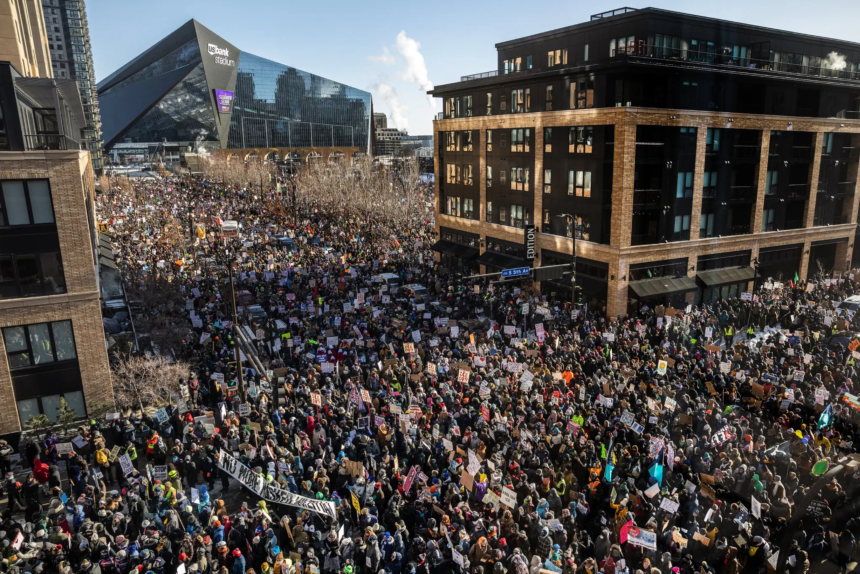
General Strike Rally Planned in Minnesota to Protest ICE, Organizers Say
Activists and labor groups across Minnesota are planning a general strike rally on Friday, aiming to protest the role of U.S. Immigration and Customs Enforcement (ICE) and what organizers describe as aggressive immigration enforcement practices.
The planned demonstration is expected to draw participants from labor unions, immigrant rights organizations, students, and community groups, with organizers calling for widespread work stoppages and public demonstrations throughout the state.
According to rally organizers, the strike is intended to pressure state and local leaders to limit cooperation with ICE and to advocate for stronger protections for immigrant communities.
Participants are being encouraged to skip work, school, and routine activities for the day as a show of solidarity. Organizers say the goal is to demonstrate how essential immigrant workers are to Minnesota’s economy and public services.
Social media posts promoting the rally have urged supporters to gather at designated locations, including downtown Minneapolis and the State Capitol area.
Organizers say the protest is fueled by growing concerns over ICE operations in Minnesota, including recent cooperation between federal immigration authorities and local agencies.
Immigrant advocacy groups argue that such cooperation creates fear in communities and discourages people from reporting crimes or accessing public services. They say the general strike is meant to amplify those concerns and demand policy changes.
State and local officials have acknowledged awareness of the planned demonstrations. Law enforcement agencies say they are preparing for potential large gatherings and emphasize that they support peaceful protest.
Authorities have not indicated that any changes to ICE-related policies are planned in response to the rally. However, some lawmakers have said they are monitoring public sentiment and remain open to discussion on immigration enforcement practices.
With organizers calling for widespread participation, some businesses and schools are preparing for possible staffing shortages and disruptions.
Labor experts note that general strikes are rare in the United States and are often difficult to sustain at scale, but even limited participation can draw significant public attention to an issue.
Public reaction to the planned rally has been divided. Supporters view the strike as a necessary step to protect immigrant communities and challenge federal enforcement practices. Critics argue that a general strike could disrupt essential services and harm small businesses.
Online discussion has reflected these divisions, with supporters emphasizing human rights concerns and opponents focusing on public safety and economic impact.
Organizers say the rally is just one step in a broader movement and warn that additional protests or actions could follow if their demands are not addressed.
As Friday approaches, state officials and law enforcement agencies continue preparations, while supporters mobilize across Minnesota.
The planned general strike rally marks a significant moment in Minnesota’s ongoing debate over immigration enforcement and ICE cooperation. Whether it results in policy changes or simply heightened public attention, the protest underscores the growing tension surrounding immigration issues at both state and national levels.
A coalition of labor unions, immigrant rights organizations, student groups, and community activists across Minnesota is preparing for a general strike rally scheduled for Friday, aimed at protesting the actions of U.S. Immigration and Customs Enforcement (ICE) and opposing cooperation between federal immigration authorities and local agencies.
Organizers describe the planned action as a statewide demonstration designed to highlight the economic and social role of immigrant workers while pressing state leaders to adopt stronger protections for immigrant communities. While general strikes are rare in the United States, supporters say the extraordinary measure reflects growing frustration over immigration enforcement policies.
What Is the General Strike Rally?
The general strike rally is being promoted as a day of collective action, encouraging workers to stay home from jobs, students to skip classes, and community members to gather at public spaces for demonstrations.
Organizers say the rally is not limited to a single location. Planned gatherings are expected in Minneapolis, St. Paul, Duluth, Rochester, and other cities, with the largest demonstrations anticipated in downtown Minneapolis and near the Minnesota State Capitol.
The strike is intended to send a message about the scale of immigrant participation in Minnesota’s workforce and the potential consequences of policies that, according to advocates, target or marginalize immigrant communities.
Who Is Organizing the Protest?
The rally is being organized by a loose coalition of labor activists, immigrant advocacy groups, and grassroots organizations. While no single group has claimed leadership, organizers say the decentralized structure reflects the broad range of communities involved.
Labor groups supporting the effort say immigrant workers play a crucial role in industries such as construction, food processing, healthcare, agriculture, hospitality, and education. Organizers argue that these sectors would struggle to function without immigrant labor.
Student organizations from several Minnesota colleges have also voiced support, framing the strike as part of a broader movement for social justice and human rights.
Why ICE Is the Focus
At the center of the protest is opposition to ICE enforcement actions and cooperation between ICE and state or local agencies. Organizers cite recent disclosures that some state departments, including corrections agencies, have cooperated with federal immigration authorities in limited cases.
Immigrant advocates argue that even restricted cooperation contributes to fear and mistrust, particularly in communities with mixed immigration status. They say concerns about detention or deportation discourage individuals from reporting crimes, seeking medical care, or engaging with public institutions.
Organizers are calling on Minnesota leaders to further limit information sharing and to adopt policies that clearly separate local governance from federal immigration enforcement.
Calls for Policy Change
Protest leaders say the general strike is meant to pressure lawmakers to take concrete action. Among their demands:
- Clear limits on cooperation between state agencies and ICE
- Greater transparency around when and how information is shared
- Expanded legal protections for undocumented residents
- Investment in community-based alternatives to detention
While the rally itself does not represent a formal negotiating body, organizers hope the visibility of the strike will force conversations at the state level.
Government and Law Enforcement Response
State and local officials have acknowledged awareness of the planned demonstrations. Law enforcement agencies say they are preparing for large crowds and emphasize that peaceful protest is protected under the Constitution.
Officials have encouraged demonstrators to follow public safety guidelines and traffic regulations. No emergency declarations or curfews have been announced in connection with the rally.
Some state lawmakers have responded cautiously, saying they support the right to protest while maintaining that immigration enforcement involves complex legal considerations beyond state control.
Potential Impact on Businesses and Schools
With organizers urging people to avoid work and school, some businesses are preparing for possible disruptions. Employers in industries heavily reliant on hourly labor have reported concerns about staffing shortages for the day.
School districts have said they will remain open, though attendance levels are uncertain. Labor analysts note that while participation in U.S. general strikes is often limited, even modest involvement can have symbolic impact and attract national attention.
Small business associations have expressed mixed views, with some owners sympathetic to immigrant rights concerns and others worried about economic losses.
Public Reaction: Support and Criticism
Public opinion on the planned strike is sharply divided. Supporters argue that dramatic action is necessary to address what they see as unjust enforcement practices and systemic inequities.
Critics, however, question the effectiveness of a general strike and argue that immigration enforcement is a federal issue beyond the control of state officials. Some have also raised concerns about disruptions to essential services.
Online discussions reflect these tensions, with advocates emphasizing human dignity and opponents focusing on law, order, and economic stability.
Historical Context of General Strikes
General strikes are uncommon in the U.S., particularly at the state level. Historically, they have been associated with moments of intense labor unrest or social change.
Labor historians note that while modern general strikes rarely achieve full participation, they can play an important role in shaping public discourse and influencing policy debates.
Organizers in Minnesota say they are aware of the challenges but believe the strike’s symbolic value outweighs logistical hurdles.
What Happens After Friday?
Organizers describe the rally as part of a longer-term movement rather than a one-day event. They say additional protests, legislative advocacy, and community organizing efforts could follow depending on the response from state leaders.
Lawmakers are expected to monitor turnout and public reaction closely. While immediate policy changes are unlikely, the strike could influence ongoing debates around immigration enforcement and state cooperation with federal agencies.
The planned general strike rally highlights the broader national debate over immigration enforcement, federal-state relations, and the role of protest in shaping public policy.
As Minnesota prepares for Friday’s demonstrations, the event underscores how deeply immigration issues resonate across communities, workplaces, and political institutions.
The general strike rally planned in Minnesota represents a rare and ambitious form of protest aimed at challenging ICE enforcement practices and advocating for immigrant rights. Whether it results in concrete policy shifts or primarily serves as a symbolic statement, the rally reflects growing tensions around immigration and the power of collective action in modern America.

